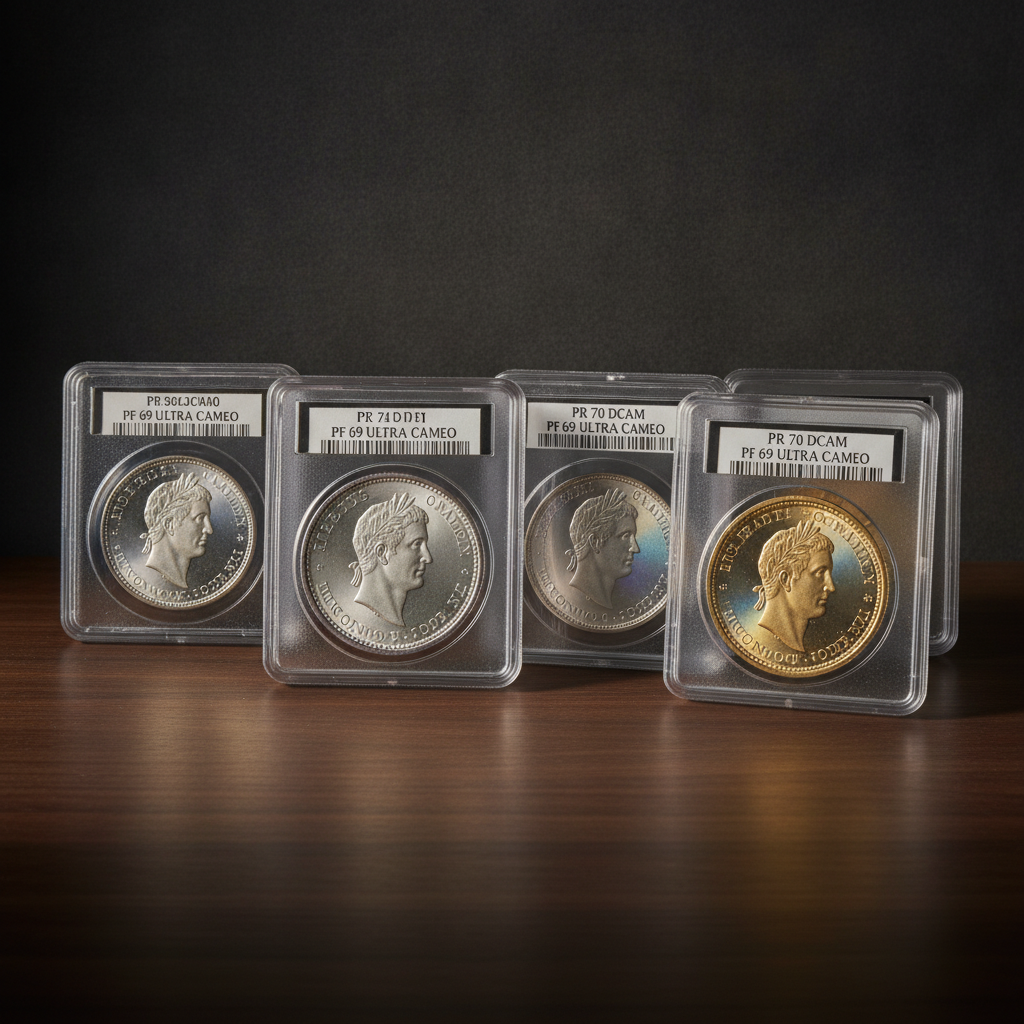
Before grading services printed the words Cameo, Deep Cameo, or Ultra Cameo on a label, someone had to teach collectors what they were even looking at. That someone was Val Webb — and now the collection he spent decades assembling is heading to auction.
Webb earned the informal title of Father of Cameos not through institutional authority but through obsession. In an era when most collectors evaluated proof coinage by strike sharpness and surface preservation alone, Webb was tilting coins under lamplight, chasing the contrast between frosted devices and mirror-polished fields. He codified a visual language that the hobby now takes entirely for granted.
The upcoming sale represents one of the most historically significant proof coin dispersals in recent memory — not because of a single trophy coin, but because of what the collection as a whole represents: a curated argument, built over a lifetime, about what makes a proof coin exceptional.
The Cameo Market Webb Helped Create
Today's collectors operate in a market where cameo contrast is a primary price driver on virtually every proof issue. A PR-65 without cameo designation and a PR-65 Deep Cameo (DCAM) can differ by multiples, not percentages. On a 1950s or early 1960s proof set coin — say, a Franklin Half Dollar or Roosevelt Dime — the spread between a flat proof and a DCAM example at the same numeric grade can exceed 10x. That pricing architecture didn't emerge from nowhere.
PCGS and NGC formalized cameo designations in their grading systems decades ago, and those designations now anchor entire market segments. Heritage Auctions, Stack's Bowers, and Goldin all regularly feature DCAM and Ultra Cameo examples as headline lots. Population reports for top-tier cameo coins in key series — early proof Lincolns, proof Walkers, 20th-century proof type — show just how scarce the finest examples remain. On many issues, PCGS PR-68 DCAM populations sit in the single digits.
Webb understood scarcity before the labels existed to confirm it. That's the part of his legacy that doesn't get enough credit.
What the Sale Could Signal
Major single-owner proof collections have a demonstrated track record of outperforming generic auction estimates, particularly when the provenance carries genuine numismatic weight. The D. Brent Pogue Collection, dispersed by Stack's Bowers across five sales between 2015 and 2016, generated over $107 million and reset price benchmarks across early American coinage. The Cardinal Collection similarly elevated market expectations for proof type. Webb's collection occupies different territory — centered on cameo contrast rather than rarity by mintage — but provenance premiums follow collector reputation regardless of series.
Proof coinage has seen renewed collector interest over the past two auction cycles, driven partly by a broader flight to quality within U.S. numismatics and partly by a generation of collectors who came up in the graded-coin era and now have the capital to pursue top-pop examples. A Webb provenance sticker on a PR-67 Ultra Cameo Franklin or a PR-68 DCAM Roosevelt isn't just decorative — it's a direct link to the man who defined what those designations mean in practice.
The auction house handling the sale has not yet released a full lot breakdown or estimates, but given the collection's scope and Webb's standing in the hobby, expect competitive bidding on the finest cameo examples across mid-20th-century proof series. These are coins that were selected by someone who understood cameo contrast better than almost anyone alive when they were acquired.
A Legacy Measured in Frost
Numismatic legacies are usually measured in registry rankings or auction records. Webb's is measured differently — in the vocabulary collectors now use without thinking, in the grading standards that shape every proof coin transaction today, and in a collection that embodies a singular, decades-long pursuit of a single visual ideal.
The coins going to auction aren't just proof coins. They're the physical record of an argument Webb won — that cameo contrast matters, that it's measurable, and that the finest examples deserve to be treated as a category apart. The market agreed with him. It's been agreeing ever since.
Whoever acquires the top lots from this sale won't just be buying coins. They'll be buying a piece of the reason those coins are worth what they are.