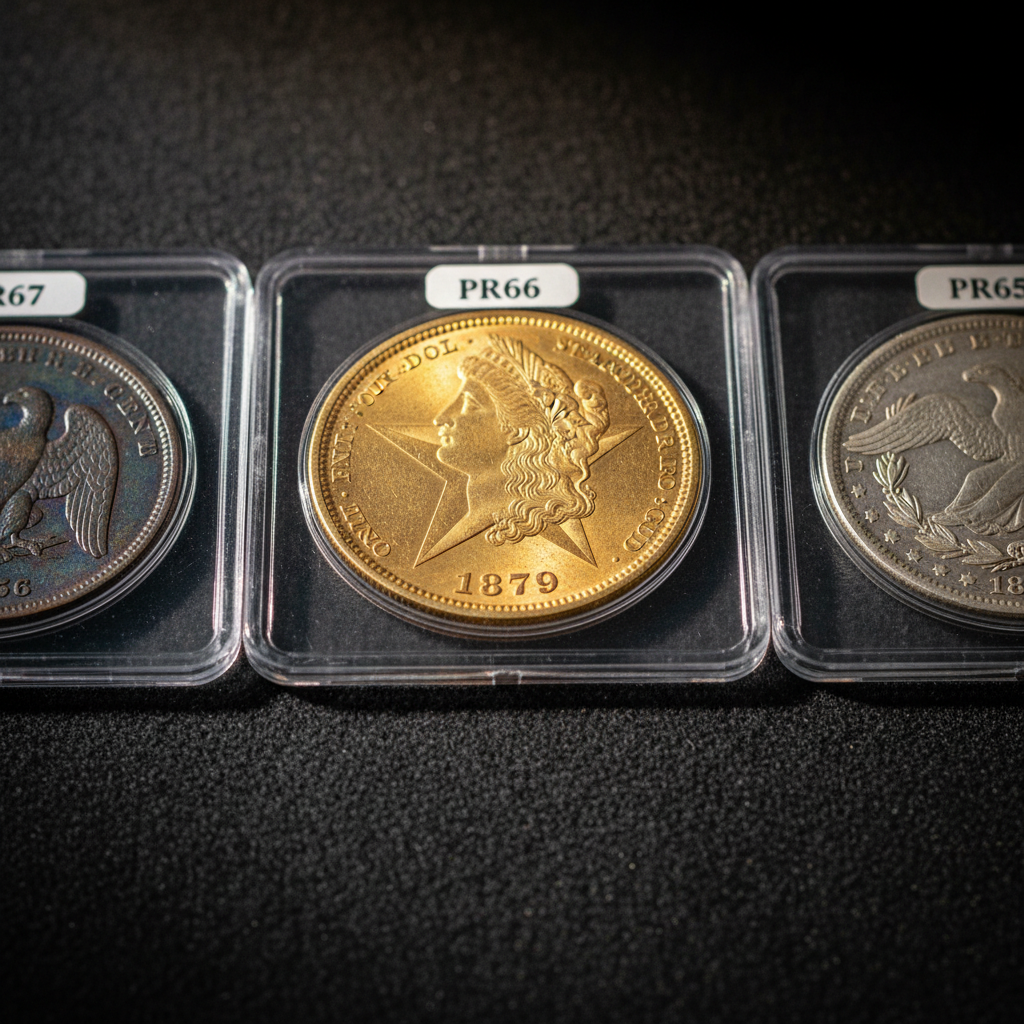
Before a coin reaches your pocket, it survives a gauntlet of design proposals, metallurgical experiments, and political battles inside the U.S. Mint. Most don't make it. The ones that don't — the patterns, the trial pieces, the experimental strikes — are among the rarest and most historically loaded objects in American numismatics.
The series runs from the 1792 Half Disme, widely regarded as the first coin struck under federal authority, through the elaborate design competitions of the Victorian era and into the twentieth century. Every piece represents a road not taken. That's not a romantic abstraction — it's the literal market thesis that has driven pattern coinage to some of the highest per-coin valuations in the hobby.
The Anatomy of a Pattern Market
Pattern coins occupy a peculiar corner of the numismatic universe. They aren't quite regular issues, but they aren't fantasies or counterfeits either. The U.S. Mint produced them intentionally, often in mintages of a few dozen or fewer, to test designs, alloys, or denominations that Congress or the Treasury was considering. That official provenance is everything — it's what separates a pattern from a curiosity and makes it a collectible with institutional weight behind it.
The standard reference for the series is J. Hewitt Judd's United States Pattern Coins, now in its tenth edition, which catalogs pieces by Judd number. Serious collectors speak in Judd numbers the way card collectors speak in Beckett numbers. A J-1776 or a J-1905 carries immediate meaning to anyone who knows the field.
Population data tells part of the story. Many patterns exist in confirmed populations of 10 to 25 examples, with some genuinely unique pieces residing in institutional collections at the Smithsonian or the American Numismatic Society. PCGS and NGC have certified patterns for decades, but the grading population reports for this series are thin by design — there simply aren't many coins to grade. That scarcity creates a market where a single fresh-to-auction example can move prices significantly, because the comp set is so small.
Heritage Auctions and Stack's Bowers have handled the marquee pattern sales over the past two decades. A Proof-66 1879 Schoolgirl Dollar — one of the most visually striking patterns ever produced, featuring Liberty with flowing hair and a coronet — has traded above $500,000 at major auction. The 1856 Flying Eagle Cent, technically a pattern struck before the small cent was officially adopted, routinely clears $6,000 to $15,000 depending on grade, and represents one of the most accessible entry points into the series for collectors who don't have six-figure budgets.
Cabinet Collections and the Names That Define the Field
No discussion of U.S. patterns is complete without acknowledging the collector dynasties that shaped the market. Bob R. Simpson, the Texas Rangers co-owner, assembled one of the most celebrated pattern cabinets of the modern era — a collection that demonstrated how institutional-grade thinking could be applied to a series that many mainstream collectors overlook. Simpson's holdings included multiple condition-census pieces and set a template for how a serious collector approaches the field: systematically, with a focus on provenance and surface quality over sheer quantity.
Charles Anderson built another of the finest pattern collections in recent memory, with particular depth in the mid-nineteenth century issues that represent the aesthetic peak of American coin design. The dispersal of collections like Anderson's and Simpson's through major auction houses has historically been the primary mechanism by which patterns change hands — private treaty sales exist, but the auction block is where the market gets made and prices get set.
The provenance chain matters enormously in this series. A pattern that passed through the collections of Virgil Brand, King Farouk, or Louis Eliasberg carries a premium that goes beyond the coin itself. These aren't just names — they're data points in a coin's biography, and biography drives value in a market where population reports are measured in single digits.
Where the Market Stands Now
Pattern coinage has historically been countercyclical to the broader rare coin market in one important respect: it doesn't move in lockstep with generic gold or silver bullion swings. When spot prices drive common-date Saints and Morgans up and down, patterns tend to trade on their own logic — rarity, eye appeal, historical significance, and the depth of the buyer pool at any given moment.
That buyer pool is real but narrow. Estimates within the dealer community put the number of serious, active pattern collectors in the United States at somewhere between 200 and 400 at any given time. That's a thin market, which cuts both ways. It means liquidity can be challenging when you're a seller without a major auction platform behind you. It also means that when two motivated collectors want the same coin — and there may only be 15 certified examples in existence — the result can be a price that looks irrational by any conventional metric and makes complete sense in context.
The 1792 Half Disme remains the gravitational center of the series. Fewer than 15 examples are known, with the finest certified specimens grading in the MS-60s at NGC and PCGS. A superb example last offered publicly drew over $1.4 million. For a coin that predates the Constitution's ratification by three years and represents the first tangible expression of American monetary sovereignty, that price isn't surprising. It might even be low.
Pattern coinage rewards the collector who does the work — who reads Judd, studies auction archives, and understands why a coin was made and why it was never made again. The series has no casual participants. That's not a flaw. That's the point.