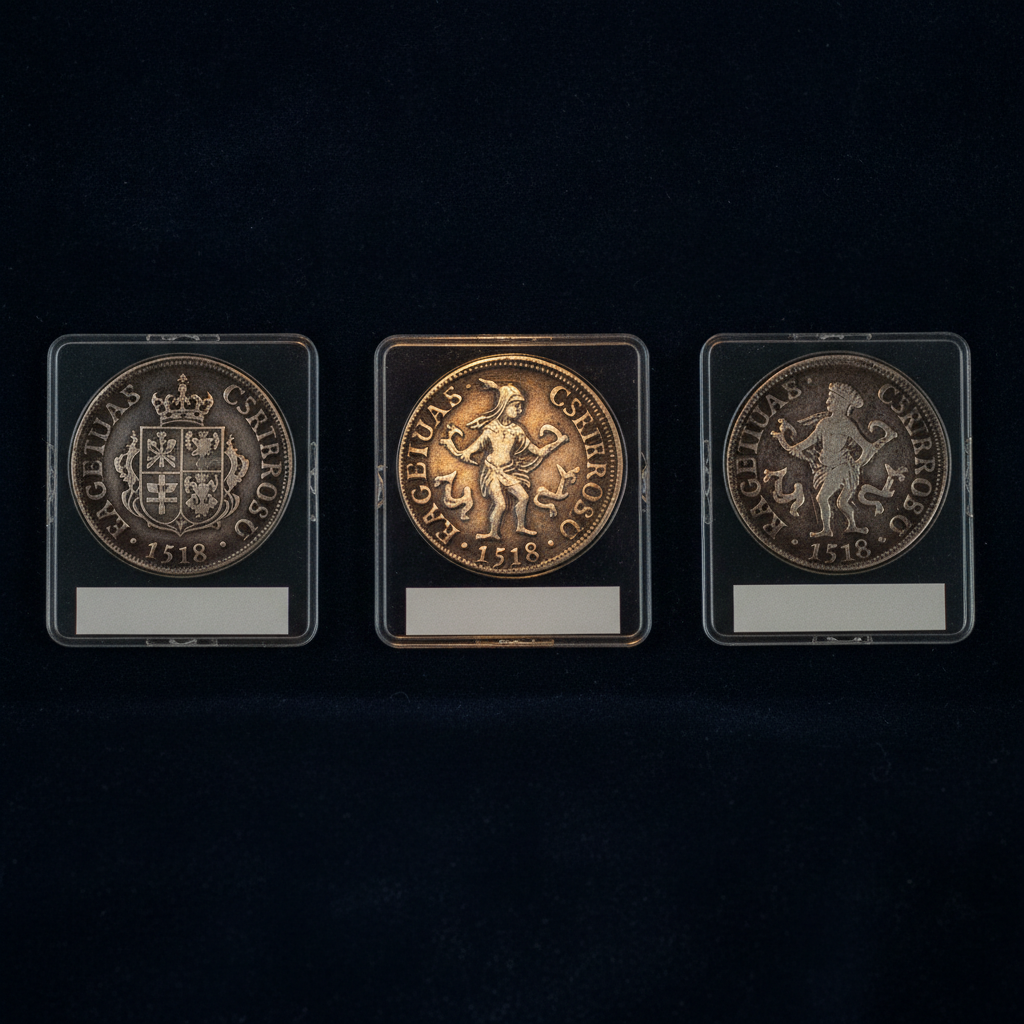
Five hundred years before anyone thought to grade a coin in a plastic slab, small silver pfennigs and batzen were circulating through the streets of Strasbourg — the same streets where, in July 1518, a woman named Frau Troffea stepped outside and began to dance. She danced for days. Within weeks, somewhere between 50 and 400 residents had joined her in what historians now call the Dancing Plague of 1518, one of the most thoroughly documented episodes of mass psychogenic illness in European history. The coins minted in that city during that era are among the most quietly compelling artifacts a medieval numismatist can hold.
This is not a story about a record auction result or a population report. It's a story about why provenance — real, documented, historically verifiable provenance — still matters more than grade in certain corners of the numismatic market.
What Was Actually Circulating in Strasbourg in 1518
The Holy Roman Empire's monetary landscape in the early 16th century was fragmented and hyperlocal. Strasbourg, a free imperial city on the Rhine, operated its own mint and issued coins under municipal authority. The dominant small silver denominations of the period included the pfennig, the kreuzer, and the schilling, alongside the larger batzen — a four-kreuzer coin that became a workhorse of regional commerce throughout Alsace and the Upper Rhine corridor.
Strasbourg pfennigs from this period typically weigh under one gram and measure 15–18mm in diameter. They are not glamorous coins. Strike quality varies considerably — hand-struck dies on irregular flans were the standard — and surviving examples in problem-free condition are genuinely scarce. NGC and PCGS combined have certified relatively few examples of early 16th-century Strasbourg municipal issues, and when they do appear, grades in the VF20–XF45 range command serious collector attention. A problem-free EF example of a Strasbourg batzen from the 1510s–1520s can realistically fetch $200–$600 at specialist auction, depending on type and eye appeal, with exceptional pieces pushing higher.
That may sound modest against the backdrop of a rare U.S. type coin or a key-date Roman denarius. But context is everything.
The Historical Weight These Coins Carry
The Dancing Plague itself is not myth or folklore embellished over centuries. It is documented in municipal records, physician accounts, and chronicles written contemporaneously. The Strasbourg city council convened to address it. Physicians were consulted. The afflicted were eventually moved to a shrine at Saverne in an attempt to end the episode. Historians including John Waller, whose 2008 book A Time to Dance, A Time to Die remains the definitive modern treatment of the event, attribute the outbreak to a combination of stress-induced psychosis, ergot poisoning theories, and the social contagion dynamics of a population under severe famine and plague pressure.
The coins minted in Strasbourg during this window — roughly 1510–1525 — passed through hands that lived this crisis. That's not a marketing line. That's the literal reality of circulated coinage. A worn Strasbourg pfennig from 1518 may have been in someone's pocket on the Rue des Grandes Arcades while the dancers convulsed nearby. That's the kind of provenance no certification label can capture, but serious collectors understand instinctively.
Medieval and early modern European coins have long occupied a peculiar space in the broader market — undervalued relative to their historical density, overlooked by mainstream auction houses that prefer the cleaner narratives of U.S. type coins or ancient Greek bronzes. Heritage Auctions and Stack's Bowers both handle world coin material regularly, but early German municipal issues rarely headline their catalogs. That creates opportunity. Specialist dealers in Germanic medieval coinage — firms operating out of Frankfurt, Munich, and Basel, as well as U.S.-based world coin specialists — remain the primary market makers here.
Building a Collection Around a Moment in History
The collector strategy that makes the most sense for material like this is thematic depth over grade chasing. A focused collection built around Strasbourg municipal coinage from 1490–1530 — bracketing the Dancing Plague with coins from the generation before and after — tells a coherent story that no single high-grade rarity can replicate. Supplement with contemporary Alsatian issues from nearby Colmar or Sélestat, and you have a regional monetary history that doubles as a window into one of the strangest documented social crises of the Renaissance.
The coins themselves don't need to be perfect. A VF example with honest wear and original surfaces is more compelling than an artificially cleaned piece in a straight holder. NGC's details designations are particularly punishing on medieval silver — cleaning, tooling, and environmental damage are common on coins that survived in the ground for centuries — so buying raw from reputable specialists with return privileges is often the smarter approach for this material.
Prices remain accessible. The historical significance is not. Somewhere in the overlap between those two facts is exactly the kind of collecting opportunity that serious numismatists have always found before the broader market catches up.