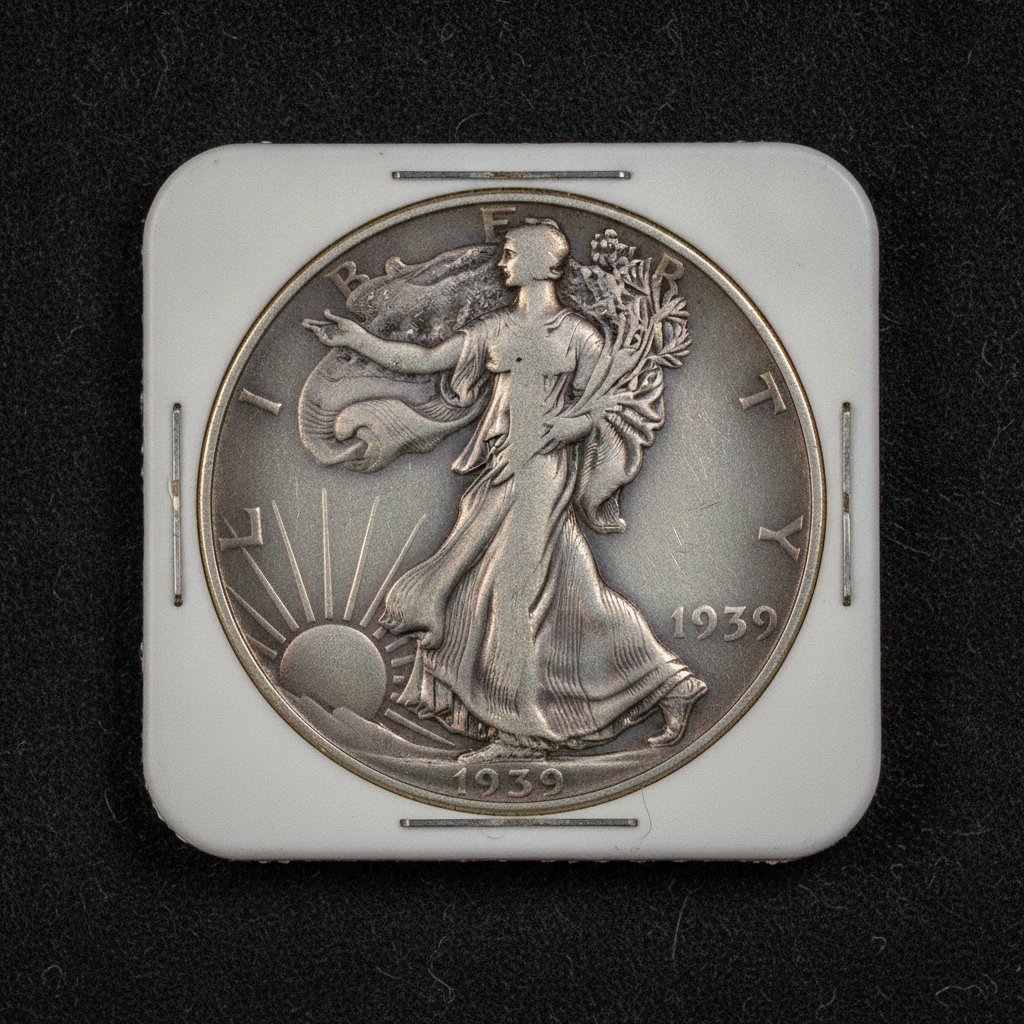
A 1939 Walking Liberty Half Dollar graded PCGS MS-65 sold through GreatCollections on June 28, 2026, for $10,419. That number demands an explanation — and the coin itself isn't it.
Philadelphia struck 6,812,000 examples of the 1939 Walking Liberty Half Dollar. It is not a key date. It is not a condition rarity in any conventional sense. A typical PCGS MS-65 example of this date trades in the $150–$300 range, and even pristine MS-67 specimens rarely crack four figures. So what happened at GreatCollections last month wasn't about the coin. It was about the plastic surrounding it.
The Holder Is the Collectible
The coin was housed in a PCGS White Rattler — one of the earliest holder designs PCGS ever produced, dating to the company's founding years in 1986. The name comes from the loose rattle the coin makes inside the oversized early slab, a byproduct of tolerances that PCGS quickly engineered out of later generations. These holders weren't meant to become collectibles. They became ones anyway.
PCGS has revised its holder design multiple times over nearly four decades, and the hobby has developed an entire sub-discipline around tracking those generations. Early holders — the White Rattler, the subsequent green label variations, the pre-barcode slabs — carry a premium that has nothing to do with the coins inside them. Collectors pursue these as artifacts of grading history, tangible evidence of the moment third-party certification changed numismatics forever.
The White Rattler sits at the apex of that collecting niche. Surviving examples in any condition are scarce. Examples housing desirable coins in high grades are rarer still. When one surfaces at auction, it draws a very specific and very motivated buyer pool — and that pool drove this otherwise unremarkable half dollar to 35 times its normal market value.
What the Comps Actually Tell Us
To understand the premium here, consider the math. PCGS has graded thousands of 1939 Walking Liberty Half Dollars across all grades. The MS-65 population is substantial — not a condition rarity. Strip away the holder, and this coin is a three-figure transaction on its best day.
But early holder premiums have been climbing for years. Heritage Auctions and Stack's Bowers have both seen early PCGS and NGC slab sales accelerate since roughly 2021, as a generation of collectors who came of age in the certification era developed nostalgia — and buying power — simultaneously. What was once a curiosity for registry completionists has become a legitimate market segment.
The $10,419 result represents roughly a $10,000 premium for the holder alone. That's not irrational. Early White Rattlers in desirable denominations with clean, original coins inside them are genuinely difficult to source. The supply is fixed — PCGS stopped making them in 1987 — and demand has only grown as the grading industry's own history becomes collectible.
For context, a comparable early NGC holder housing a common-date Morgan Dollar in MS-65 fetched over $4,500 at Heritage earlier this year. The Walking Liberty result blows past that benchmark, suggesting either a particularly motivated underbidder, an exceptionally well-preserved example of the White Rattler itself, or both.
A Niche With Real Momentum
GreatCollections has quietly become one of the better venues for this kind of sale. Their online platform attracts specialist buyers who know exactly what they're looking at, and the transparency of their bidding history makes it easy to see genuine competition rather than a single outlier bid. The $10,419 hammer on this coin wasn't an accident — it was the product of at least two serious collectors who understood the scarcity.
What makes the early holder market genuinely interesting from an investment standpoint is the asymmetry. The downside is bounded by the coin's intrinsic numismatic value — in this case, a floor somewhere around $200. The upside is driven by collector sentiment around grading history, which has shown no signs of cooling. The risk profile looks nothing like buying a raw coin or even a standard modern slab.
That said, provenance matters enormously in this niche. Not every coin claiming to be in a White Rattler is what it appears. Sophisticated buyers examine label fonts, holder dimensions, and surface characteristics to authenticate early slabs — a due diligence layer that doesn't exist when buying a 2024-generation PCGS holder.
A common coin. A historic holder. $10,419. The 1939 Walking Liberty Half Dollar didn't earn that price — but the piece of plastic holding it absolutely did.