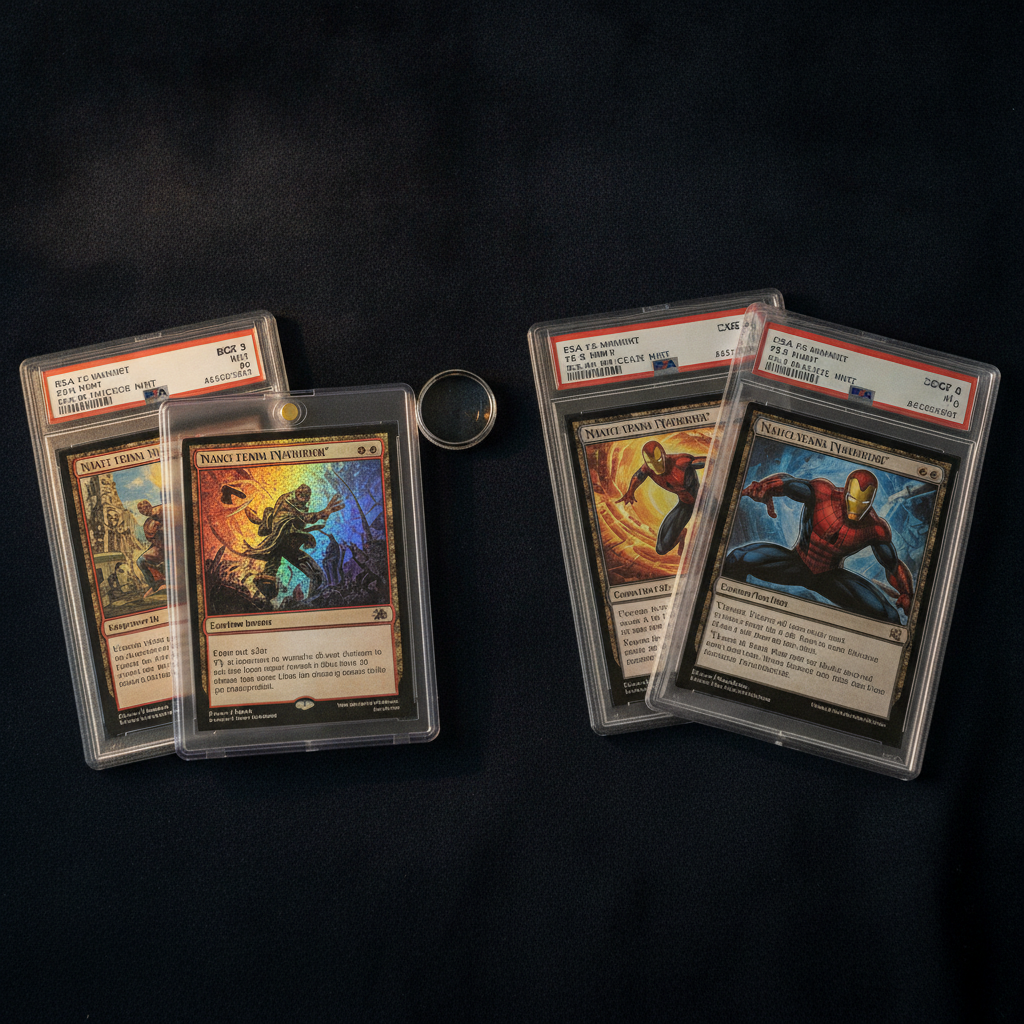
Marvel Super Heroes hit local game stores on June 26, and the secondary market didn't wait for the dust to settle. Within days of release, Magic: The Gathering's most anticipated crossover set of 2025 produced exactly the kind of bifurcated price action that experienced speculators should have seen coming — and that casual buyers almost certainly didn't.
The short version: older staples are climbing, and the set's own chase cards are already giving back ground. Two markets, moving in opposite directions, at exactly the same moment.
The Upgrade Effect Is Real — and It's Moving Prices Now
Every major Commander precon release triggers the same downstream effect. Players crack the box, sleeve up the precon, and immediately start hunting for upgrades. Marvel Super Heroes is no different — except the IP draw here is significantly broader than a typical set. This isn't just enfranchised Magic players buying in. Marvel's brand pulls from a collector base that overlaps with comics, sports cards, and pop culture memorabilia. That's a wider funnel of buyers chasing the same pool of older staples.
The result is predictable in hindsight: synergistic cards from older sets that slot cleanly into the new Commander archetypes are seeing real demand spikes. Not speculative movement driven by Discord buyout lists — actual transactional volume at elevated prices. The distinction matters. Buyout spikes collapse within 72 hours when the coordinated buying stops. Organic upgrade demand tends to hold, or at least decline gradually, because it's spread across thousands of individual purchasing decisions rather than one concentrated push.
For dealers, this is the window. Upgrade demand peaks in the first two to three weeks post-release, before the market fully reprices and before players who pulled relevant cards from packs start listing them. If you're sitting on older staples with Marvel-adjacent utility, this week and next are your exit point.
The Spec Hype Is Unwinding — Right on Schedule
On the other side of the ledger, the preview-season speculation that drove Marvel Super Heroes chase cards to elevated pre-release prices is deflating. This was entirely foreseeable. Hype cycles in TCG markets follow a remarkably consistent pattern: prices peak during spoiler season when supply is zero and imagination is unlimited, then correct sharply once packs are actually being opened and real supply enters the market.
The set's top-end cards — the serialized treatments, the showcase variants, the cards that generated the most social media engagement during preview season — are sliding as collector and player supply floods secondary market platforms. TCGPlayer listings are stacking up. eBay sell-through rates are compressing. The gap between ask and transaction price is widening, which is always the early signal of a market looking for a new floor.
This doesn't mean the set is a disaster. It means the market is doing exactly what markets do: correcting inflated pre-release expectations against actual supply reality. Some of these cards will find genuine equilibrium at prices that make sense for their playability and scarcity. Others — particularly the cards that were hyped primarily on IP recognition rather than mechanical utility — may struggle to hold meaningful value once the novelty fades.
Serialized cards are the wild card here. Low-pop serialized variants from major IP crossovers have shown resilience in other TCG markets, particularly in graded form. A PSA 10 copy of a numbered-to-500 or numbered-to-100 Marvel Super Heroes variant occupies a different market segment than raw copies listed on TCGPlayer. If the set has lasting collector appeal — and the Marvel brand gives it a real shot — the graded serialized tier could stabilize well above where raw singles settle.
What the Divergence Actually Tells You
The hot/cold split playing out this week is a clean illustration of why TCG investing requires treating the product launch and the secondary market as two separate stories running simultaneously.
The product launch story is about the new set — its cards, its mechanics, its IP. That story peaked during preview season. It's now in the correction phase, and the duration of that correction depends on how deep player demand actually runs once the initial excitement normalizes.
The secondary market story is about everything the new set touches — the older cards it makes more relevant, the archetypes it reinforces, the Commander staples it elevates. That story is just beginning. And right now, that's where the money is moving.
Marvel Super Heroes may ultimately prove to be one of Magic's more significant crossover releases, or it may join the long list of sets that generated outsized preview-season enthusiasm and middling long-term value. Either way, the week of June 29 is a data point worth remembering: the set that everyone was buying before release is the set everyone is selling now, and the cards no one was talking about are the ones going up.