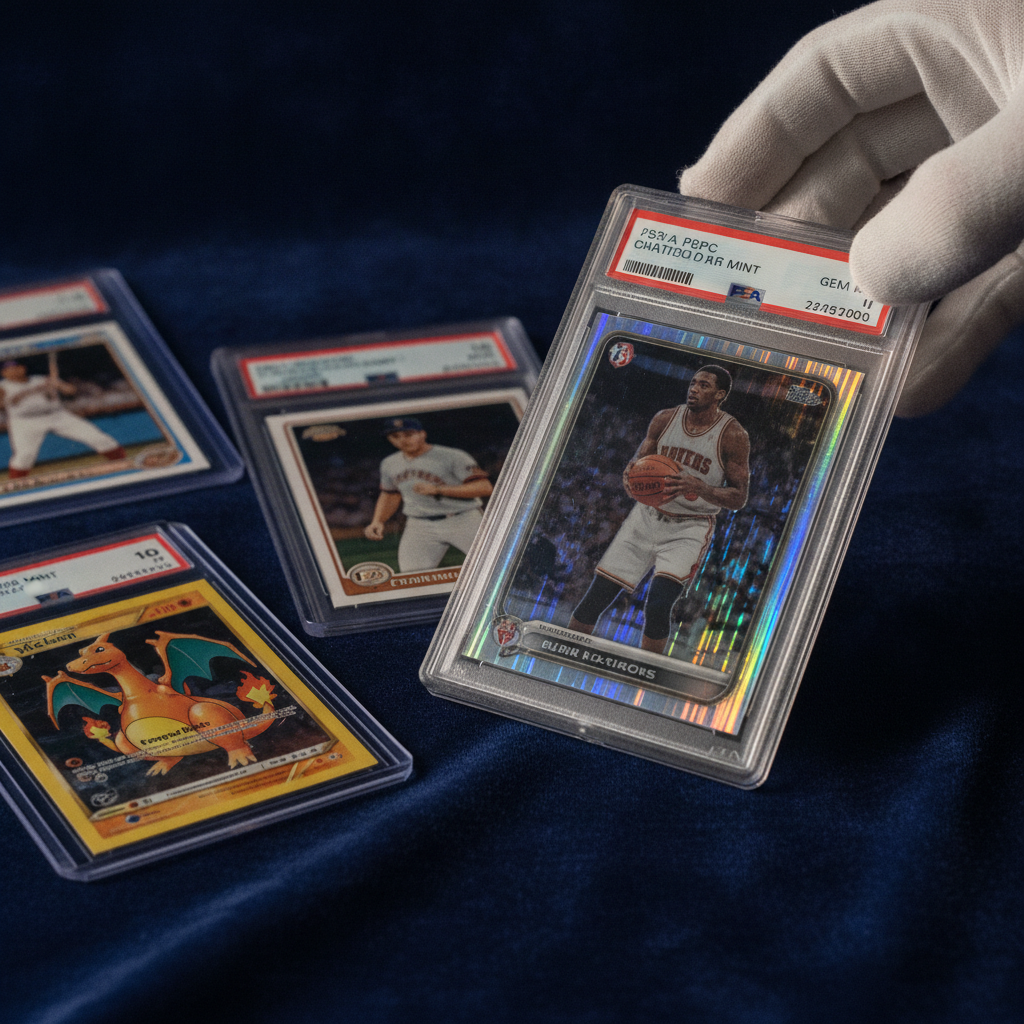
A collector in Ohio paid $14,000 for a PSA 9 LeBron James 2003-04 Topps Chrome rookie in early 2021. By the end of 2022, comparable copies were clearing $5,800 at Heritage. He hadn't done anything wrong, exactly — he'd bought a legitimate, authenticated card from a reputable seller. What he'd done wrong was skip the portfolio thinking. He bought one card, in one grade, at one point in the cycle, with no plan for what came next.
This guide is for the collector who doesn't want to be that guy. Whether you're sitting on $500 or $50,000, the principles that separate a trading card portfolio from a trading card pile are the same. Let's build something that actually works.
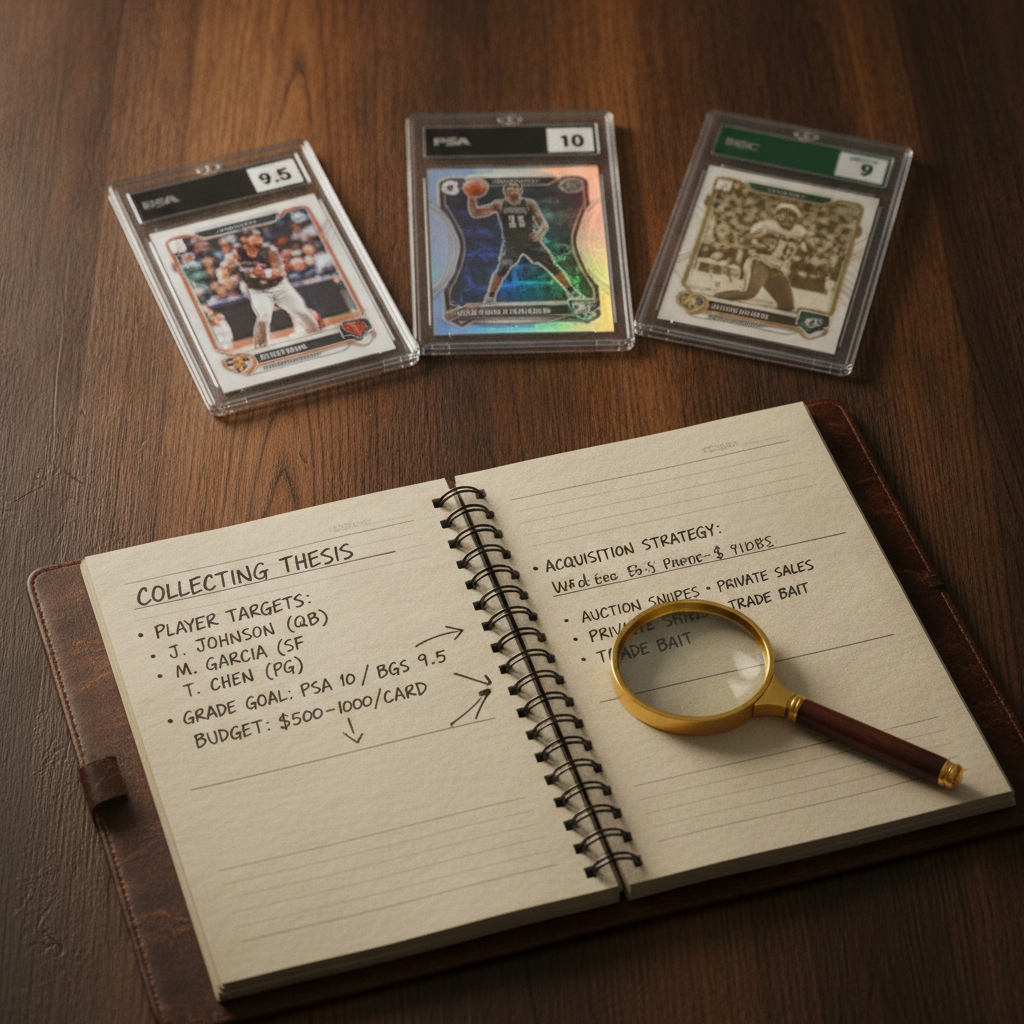
Step 1: Define Your Collecting Thesis Before You Buy Anything
The single most expensive mistake new collectors make is buying cards they find interesting rather than cards that fit a coherent strategy. Interesting cards are everywhere. A coherent strategy is rare — and it's what separates the collectors who build equity from the ones who liquidate at a loss three years later.
Your thesis doesn't need to be complicated. It needs to be specific.
Some examples of actual working theses:
- Modern basketball rookies, PSA 10 only, Hall of Fame-trajectory players, purchased within 18 months of their debut season. This thesis has a clear entry point, a clear grade target, and a clear athlete filter.
- Vintage baseball pre-1970, raw or low-pop graded, regional stars and short-prints that the mainstream market ignores. This is a value-hunting thesis with a defined era and a defined gap in market attention.
- Soccer cards, specifically Premier League and Champions League stars, BGS 9.5 or PSA 10, targeting the North American collector base that's still catching up to international demand. This is a macro-trend thesis with a geographic arbitrage angle.
Notice what all three have in common: a sport or era, a grade or condition standard, a player filter, and an implicit theory about why prices should rise. That last piece — the why — is the one most collectors skip. If you can't articulate why a card should be worth more in three years than it is today, you don't have a thesis. You have a hunch.
Pro Tip: Write your thesis down. Literally. One paragraph, on paper or in a notes app. Every time you consider a purchase, ask whether it fits what you wrote. If it doesn't, you need either a compelling exception or a thesis revision — not an impulse buy.
Your thesis will also shape your budget allocation. A vintage thesis demands patience and a tolerance for condition risk on raw cards. A modern PSA 10 thesis demands speed — you want to submit or buy graded before population reports balloon. A soccer thesis right now demands geographic awareness, because cards trading at $200 on eBay.com are sometimes moving at $350 on European platforms like Catawiki. Know your market.
Step 2: Understand the Grade Curve — and Where the Value Actually Lives
Grading is not a binary pass/fail system. It's a curve, and the value on that curve is wildly non-linear. Understanding this is worth more than any individual purchase decision you'll make.
Take the 2000 Topps Chrome Tom Brady rookie as a case study. As of mid-2024, a PSA 6 copies sell in the $800–$1,200 range. A PSA 8 runs $3,500–$5,000. A PSA 9 clears $12,000–$18,000 depending on centering and eye appeal. A PSA 10? The last confirmed Heritage sale was $396,000 in August 2021, and with a population of fewer than 30 copies, the floor hasn't dropped nearly as far as the broader market. That's not a linear curve. That's a cliff.
The lesson: grade premiums are exponential, not incremental. A one-point difference at the top of the scale can mean a 3x to 10x price multiplier. This creates two distinct portfolio strategies, and you need to consciously choose one.
The High-Grade Strategy means targeting PSA 10s and BGS 9.5s exclusively, accepting that you'll own fewer cards, paying significant premiums, and betting that top-pop scarcity holds. This works best for flagship rookies of established stars — cards with deep collector bases and long-term demand.
The Value-Grade Strategy means targeting PSA 7s and 8s of cards where the 9/10 premium is irrational relative to the underlying demand. Vintage cards in particular often have grade curves where an SGC 6 or PSA 7 represents the sweet spot — high enough to confirm authenticity and condition legitimacy, low enough that you're not paying a scarcity premium for a number on a label.
Pro Tip: Before buying any graded card, pull the PSA or BGS population report at psacard.com or beckett.com/grading. What you're looking for is not just the total population — it's the distribution. If 60% of all graded copies are PSA 9 or above, the scarcity premium at 9 is illusory. If 90% of copies grade below an 8, a PSA 8 is genuinely scarce and may be underpriced relative to its population.
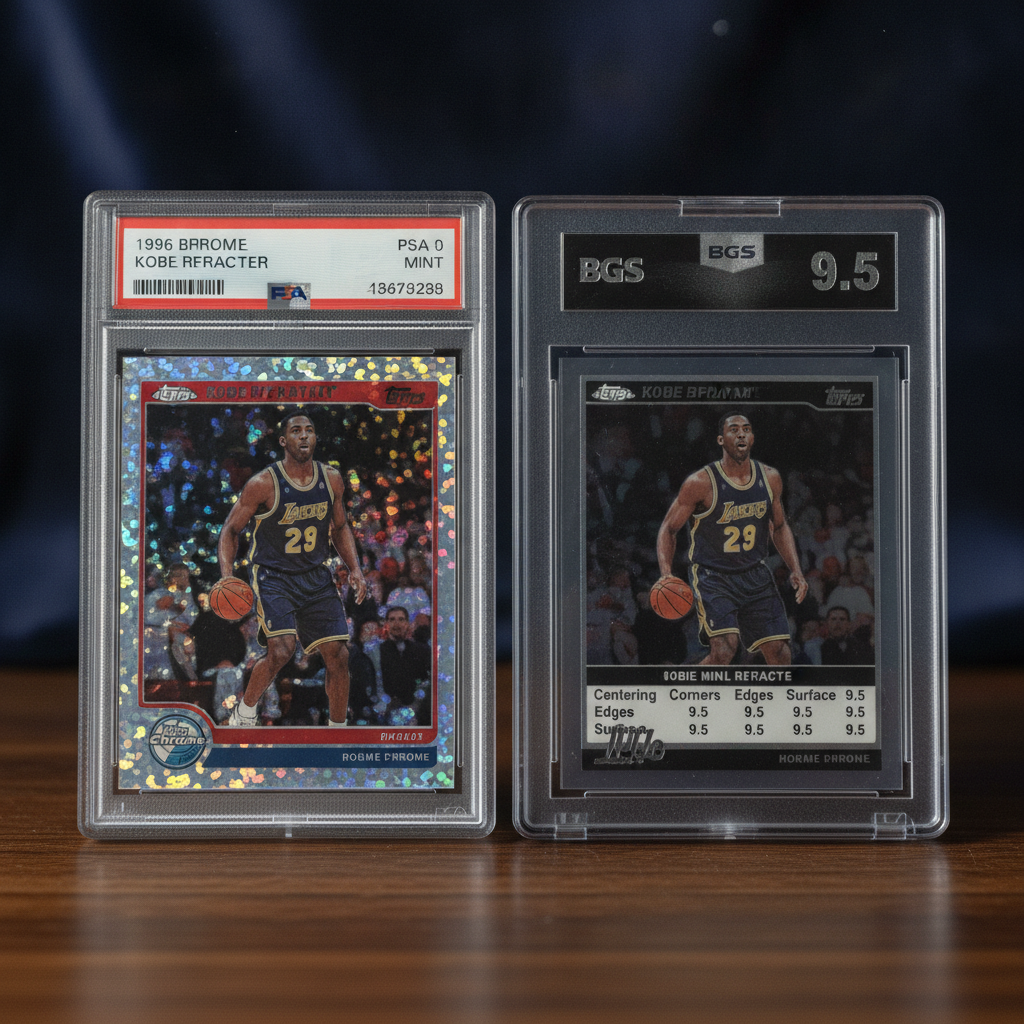
One more thing on grading companies: the label matters. PSA dominates the trading card market for liquidity — a PSA 10 will always find a buyer faster than a BGS 10, even if Beckett's 10 is theoretically stricter. But BGS 9.5s with a 10 centering subgrade carry a meaningful premium over standard BGS 9.5s, and that subgrade detail is something many newer collectors miss entirely. For modern cards where centering is the primary grading risk, that subgrade data is crucial due diligence.
Step 3: Build a Sourcing Strategy Across Multiple Channels
Buying everything from eBay is like doing all your grocery shopping at a convenience store. You'll find what you need, but you'll overpay every time, and you'll miss the best stuff entirely.
A mature sourcing strategy uses at least four channels, each serving a different function in your portfolio.
1. Auction Houses for Significant Purchases. For any card above $1,000, the major auction platforms deserve serious consideration. Heritage Auctions runs bi-monthly sports card sales and provides the best price transparency in the hobby — their archives are the closest thing trading cards have to a Bloomberg terminal. Goldin has positioned itself as the volume leader for modern cards, running weekly auctions that move enormous quantities of graded modern material. PWCC Marketplace operates a hybrid model with both fixed-price vault inventory and weekly auctions. Each platform has different buyer's premiums — Heritage charges 20% on the first $100,000, which matters enormously on a $15,000 purchase. Factor that into your ceiling bid.
2. eBay for Liquidity and Comparables. eBay remains the world's largest trading card marketplace, and its sold listings are indispensable for real-time price discovery. But buying at eBay retail means paying retail. Use the Advanced Search → Sold Listings filter obsessively. This is how you know whether a card is priced fairly before you buy it anywhere.
3. Direct Collector Networks for Below-Market Deals. The best prices in this hobby move through communities, not platforms. Reddit's r/tradingcardcommunity and sport-specific subreddits run active buy/sell/trade threads. Facebook Groups — particularly sport-specific and era-specific ones — still move enormous volume at prices that reflect collector-to-collector transactions rather than dealer margins. Building a reputation in these communities as a fair, fast, and communicative buyer is a long-term asset.
4. Local Card Shows and Shops for Raw Card Opportunities. If your thesis includes raw vintage or regional stars, local shows are irreplaceable. The National Sports Collectors Convention (held annually, most recently in Cleveland in 2024) is the single best sourcing event in the hobby. Regional shows in major cities run year-round. The dealers at these shows are often working from older price guides and may not have updated their comps for recent auction results. That gap is your opportunity.
Pro Tip: Use 130point.com or Market Movers (the premium analytics platform from Beckett) to track price trends before you source. Knowing that a card's 90-day average is trending up 15% before you walk into a show gives you confidence to pay a fair price rather than low-ball and lose the deal.
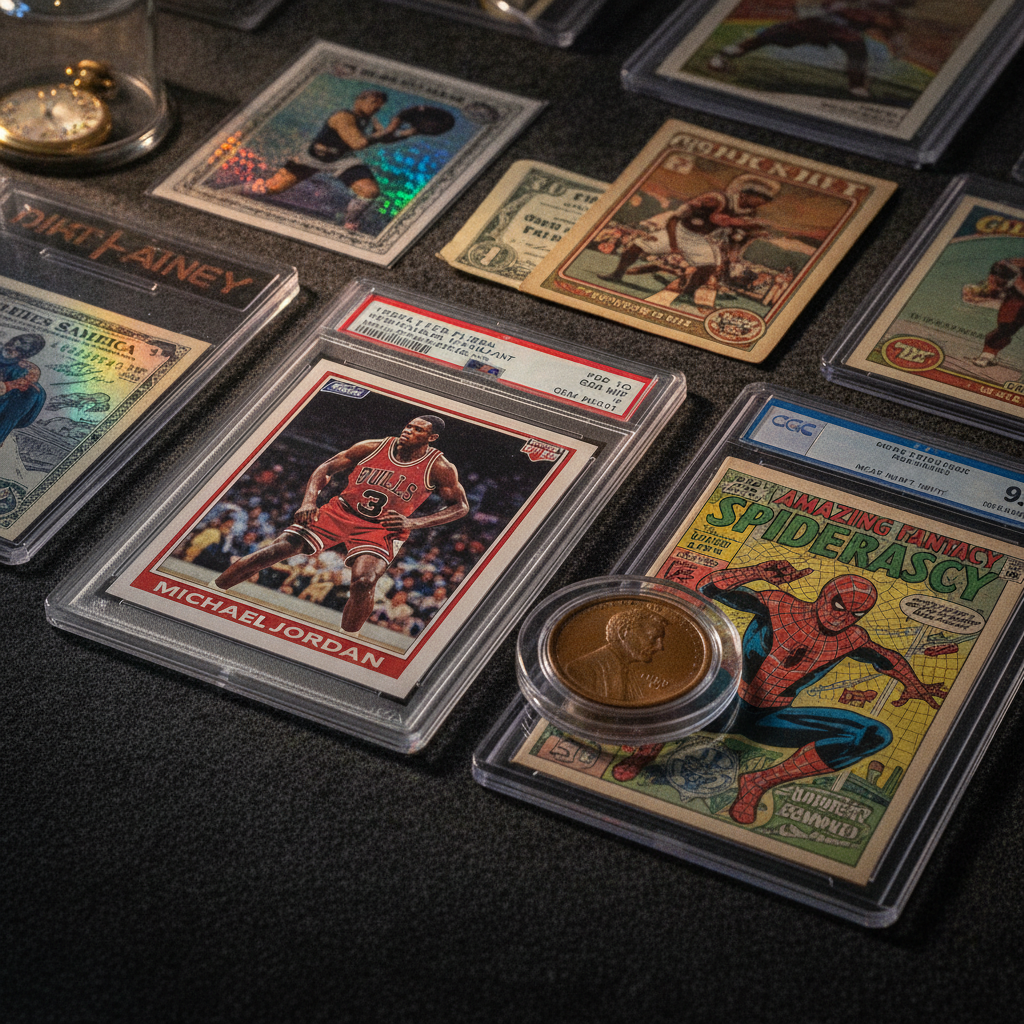
Step 4: Track, Protect, and Document Everything
Your portfolio is only as strong as your records. This is the part of the hobby that nobody finds exciting, and it's the part that saves collectors thousands of dollars when it's time to sell, insure, or prove provenance.
Start with inventory management. Collectr and Card Ladder are the two most widely used portfolio tracking apps in the hobby. Both allow you to log purchases with cost basis, current estimated value, and grade data. Card Ladder has the edge on price history charts for graded cards. Collectr has the edge on raw card tracking and overall portfolio visualization. Many serious collectors use both.
Physical protection is non-negotiable. Graded slabs from PSA, BGS, and SGC are already protected — but they're not indestructible. Store slabs vertically in Ultra Pro Slab Pages in a binder, or in dedicated slab boxes from BCW Supplies. Keep them away from direct sunlight (UV fading is real and irreversible on vintage cards) and away from humidity extremes. A $30 hygrometer from Amazon in your storage area is cheap insurance.
For raw cards awaiting submission, toploaders are the minimum — but for anything valuable, use Card Savers (the semi-rigid holders that PSA and BGS actually require for submission) rather than rigid toploaders, which can crack and damage edges in transit. For storage of raw cards you're holding long-term, penny sleeves plus toploaders plus team bags is the standard three-layer approach.
Insurance deserves a dedicated paragraph. Homeowner's and renter's insurance policies typically cap collectibles coverage at $1,500–$2,500, which is laughably inadequate for any serious collection. Collectibles Insurance Services (CIS) and American Collectors Insurance both offer dedicated collectibles policies that cover cards at agreed value — meaning if your PSA 9 Brady rookie is insured for $15,000 and it's stolen, you get $15,000, not whatever depreciated value a general insurer decides to assign. Annual premiums for $50,000 in coverage typically run $200–$400. That's not a cost. That's a cost of doing business.
Documentation means receipts, photos, and provenance records for every significant purchase. A photo of the card's front, back, and any identifying marks — plus the original purchase receipt — creates a paper trail that matters for insurance claims, estate planning, and resale. Store these digitally with a cloud backup. Google Drive or Dropbox costs almost nothing and has saved more than one collector from a catastrophic loss.
Step 5: Know When to Sell — and When to Hold
The hardest discipline in collecting isn't buying. It's selling when the thesis has played out — especially when you love the card.
Emotion is the enemy of portfolio performance. The collector who held every LeBron rookie through the 2021 peak because he loved LeBron watched his portfolio drop 50–60% over the following 18 months. The collector who set a target — say, 2x cost basis — and executed on it when the market hit that number, walked away with real gains and capital to redeploy.
Build exit criteria into your thesis from day one. Decide in advance: what price, what time horizon, or what market signal triggers a sale? Common frameworks include:
- Price targets: Sell when the card reaches a specific dollar amount or a specific multiple of your cost basis.
- Population triggers: Sell when the PSA 10 population crosses a threshold (say, 500 copies) that signals the scarcity story is eroding.
- Career events: Sell when the athlete retires, wins a championship, or achieves a Hall of Fame induction — these events create predictable demand spikes that are often the best exit windows.
- Time-based rules: Sell after a fixed holding period (say, 3–5 years) regardless of price, to force capital rotation into fresher opportunities.
Timing your sale to the right platform matters as much as timing the market. For cards above $5,000, consigning to Heritage or Goldin will almost always net a higher final price than a fixed-price eBay listing, even after the seller's commission. For cards in the $500–$2,000 range, PWCC's weekly auctions or eBay with a well-written listing and strong photos are usually the most efficient channels. Below $500, direct community sales through Reddit or Facebook avoid platform fees entirely and often move faster.
Pro Tip: Timing your auction consignment to coincide with relevant sports events — the NBA Finals, the Super Bowl, Hall of Fame announcement week — is one of the most reliable ways to extract a premium. Heritage and Goldin both schedule their flagship sales around these windows. Submitting your consignment 6–8 weeks before the relevant event gives the auction house time to catalog and market the card properly.
- Write a specific collecting thesis before any purchase — sport, grade standard, player filter, and a clear theory of why prices rise.
- Grade premiums are exponential at the top of the scale. Always pull population reports before buying and understand the distribution, not just the total count.
- Source across at least four channels: major auction houses for significant buys, eBay for price discovery, collector communities for below-market deals, and local shows for raw card opportunities.
- Use Card Ladder or Collectr for portfolio tracking. Protect slabs properly, insure everything above your homeowner's policy cap, and document every purchase.
- Build exit criteria into your thesis from day one. Price targets, population triggers, career events, and time-based rules all work — but you need one before you buy, not after.
- Platform selection at exit matters. Auction houses outperform for high-value cards; direct community sales outperform for sub-$500 material.
Your Next Steps
Here's what to do this week, in order:
- Today: Write your collecting thesis. One paragraph. Be specific about sport, era, grade standard, player criteria, and the macro reason prices should rise. If you can't write it, you're not ready to buy.
- This week: Download Card Ladder and input every card you already own with purchase price and current grade. You need a baseline before you can measure progress.
- Before your next purchase: Pull the PSA population report for any card you're considering. Look at the grade distribution, not just the top-grade pop. Check the 90-day sold history on eBay's advanced search. Compare to Heritage's archived results for the same card.
- Within 30 days: Audit your physical storage setup. Are your slabs protected from UV and humidity? Are your raw cards in Card Savers? Do you have a dedicated collectibles insurance policy, or are you relying on homeowner's coverage?
- Ongoing: Set a calendar reminder to review your portfolio against your thesis every 90 days. Ask: does each card still fit the thesis? Has any exit criterion been triggered? Is there a better use of capital somewhere else in the market?
The collectors who build lasting value in this hobby aren't the ones with the best eye for cards. They're the ones with the most disciplined process. Build the process first. The great cards will follow.