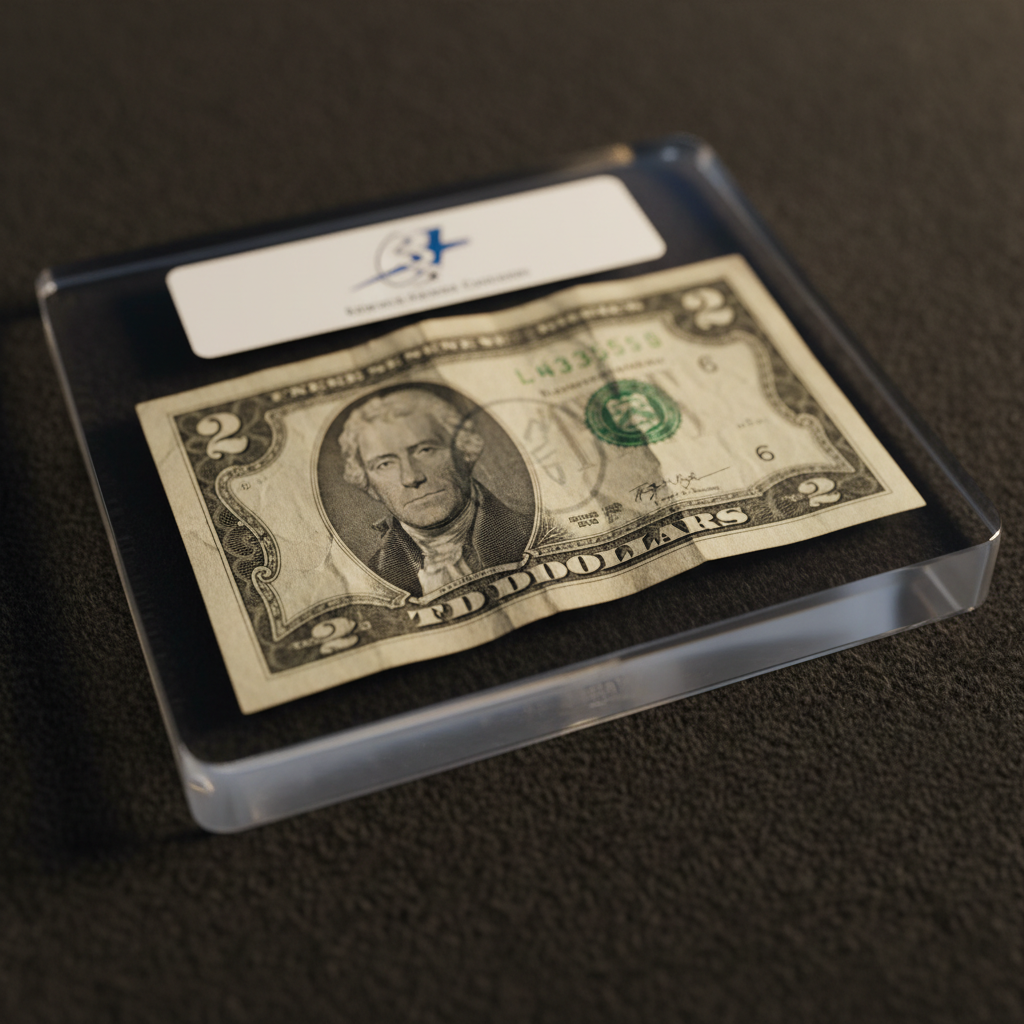
A Series 1953 $2 United States Note — serial number A10241591A — didn't spend its life in a cash drawer. It rode to the Moon and back aboard Apollo 17, tucked away by the last man to walk on the lunar surface. RR Auction is offering that bill in its upcoming Space Exploration, Aviation, and Meteorites sale, with an estimate north of $30,000 and a closing date of April 23.
That's a roughly 1,500,000% premium over face value. The math is absurd. The reasoning is not.
What Makes This Note Different From Every Other $2 Bill on Earth
Gene Cernan signed and flight-certified the note, placing it among a narrow category of lunar artifacts with unimpeachable provenance: objects physically carried to the Moon by the astronauts themselves. Cernan commanded Apollo 17 in December 1972, the final crewed lunar mission of the 20th century. His moonwalk lasted over 22 hours across three EVAs — more total surface time than any other astronaut in history. When he climbed back into the lunar module for the last time on December 14, 1972, no human being has walked on the Moon since.
That historical finality matters enormously in the collectibles market. Cernan isn't just an Apollo astronaut; he's the bookend of an era. Items connected to him carry a symbolic weight that even fellow Apollo commanders can't fully match.
The choice of currency as a flight item wasn't unusual for the era. Astronauts routinely carried personal preference kits — small pouches of mementos, covers, and keepsakes — on missions. Postal covers flown on Apollo flights have long been a staple of the space memorabilia market, but currency is rarer. A signed and flight-certified banknote from the last Apollo mission is a different animal entirely.
The Space Memorabilia Market at This Price Point
RR Auction has built one of the most credible pipelines for space-flown material in the hobby. Their provenance documentation standards are rigorous, and the flight-certified designation here carries real weight — this isn't an item that merely passed through a training facility or sat in a display case at NASA.
For context, Apollo-flown covers in average condition from lesser missions routinely clear $1,000–$5,000 at auction. Cernan-signed material without flight provenance — photographs, lithographs, books — typically lands in the $300–$800 range depending on format. A flight-certified, signed artifact from Apollo 17 specifically occupies a tier well above either category.
The $30,000-plus estimate is aggressive but defensible. In 2022, a Cernan-signed Apollo 17 lunar surface photograph sold through Heritage Auctions for over $15,000. A flown Beta cloth patch from the same mission brought more than $25,000. Currency, by contrast, is almost never seen in this context — there's no reliable population to benchmark against, which cuts both ways. Scarcity supports the estimate; the absence of direct comps introduces uncertainty.
What the market has demonstrated consistently is that Apollo 17 material, and Cernan material specifically, commands a premium that has only grown since his death in January 2017. Post-mortem appreciation is a documented pattern across space memorabilia — Neil Armstrong items saw significant price acceleration after his passing in 2012, and Cernan's trajectory has followed a similar curve.
The Collector Calculus
This lot will appeal to a narrow but deep-pocketed segment of the market: serious space history collectors, institutional buyers, and the kind of investor who understands that lunar-flown artifacts exist in genuinely finite supply. No more Apollo missions means no new inventory. Every authenticated piece that surfaces is competing against a fixed ceiling of what was ever brought back.
The Series 1953 $2 United States Note itself is a collectible in its own right — it predates the more familiar Federal Reserve Notes and carries a red Treasury seal, a design detail that adds a layer of numismatic interest for currency collectors who might otherwise have no stake in the space memorabilia world. Whether that crossover appeal moves the needle at auction is an open question, but it doesn't hurt.
At $30,000, a buyer is acquiring one of the more unusual intersections of American monetary history and space exploration history that the market is likely to see this year. The bill is worth two dollars. The story it carries is worth considerably more — and on April 23, the market will say exactly how much more.