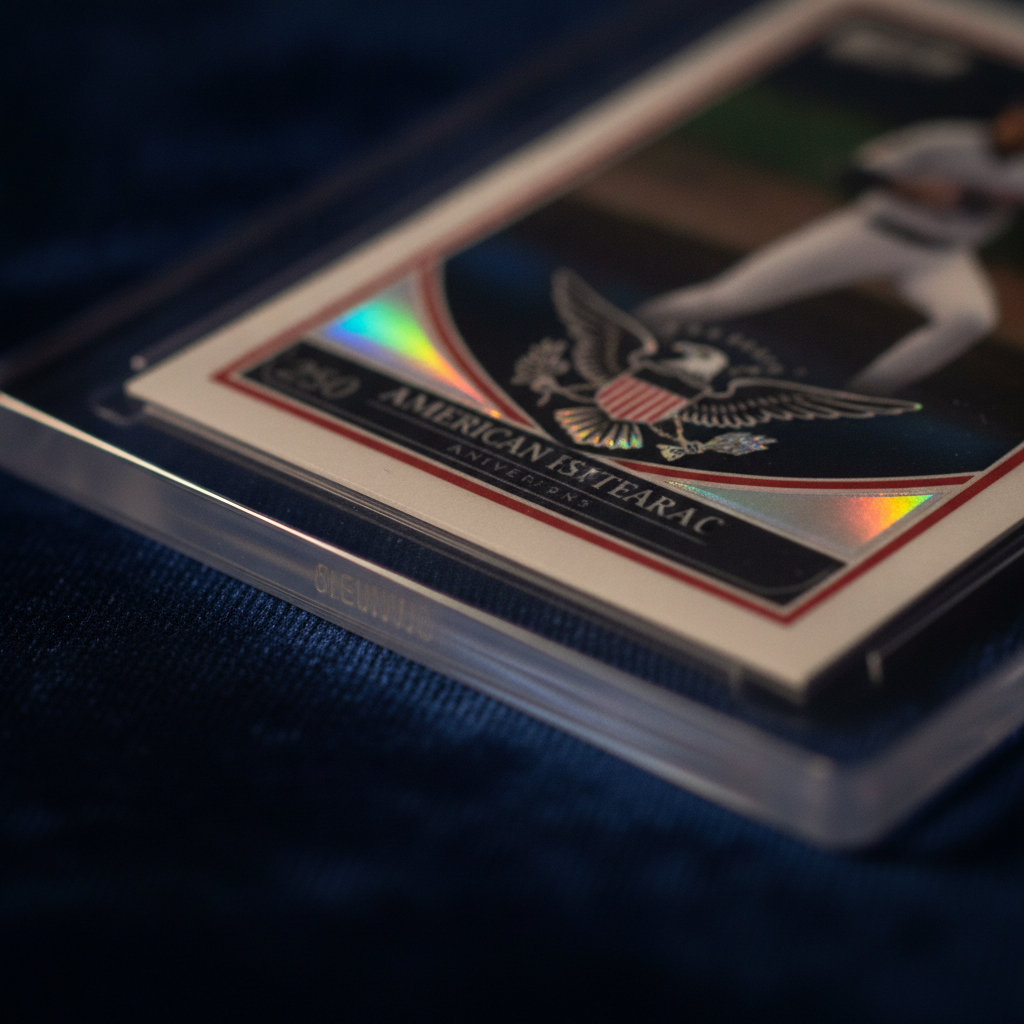
Two hundred and fifty years is a long time to accumulate stuff. And Americans, it turns out, are very good at holding on to things.
As the United States marks its semiquincentennial this Independence Day, the collectibles market is quietly having a moment that has nothing to do with rookie cards or pop culture grails. Americana — the broad, sprawling, sometimes undervalued category of patriotic ephemera, historical documents, political memorabilia, and folk art — is reasserting itself as one of the most emotionally resonant corners of the hobby. And in a market that has spent the last three years recalibrating after the pandemic-era boom, emotional resonance is no small thing.
A Category With Deep Roots and Uneven Recognition
Americana has always occupied an awkward position in the collectibles hierarchy. It lacks the clean grading infrastructure of coins or cards. Its auction results are harder to benchmark. A hand-painted 19th-century trade sign and a signed Declaration of Independence broadside technically live in the same category, which makes comparables nearly impossible to standardize.
But the auction data tells a compelling story. Heritage Auctions, which runs one of the most active Americana departments in the country, has seen consistent demand for founding-era documents and Revolutionary War-period artifacts. A 1776-dated Continental Congress broadside can fetch anywhere from $8,000 to well over $200,000 depending on provenance, condition, and which printer's imprint it carries. At the high end, a document bearing an authentic signature from a Founding Father — Jefferson, Adams, Hamilton — enters a different stratosphere entirely. Stack's Bowers and Heritage have both recorded six-figure results for signed presidential correspondence from the founding generation in the last 24 months alone.
Coins tell a parallel story. The 1776 Continental Dollar, one of the earliest coins struck in the name of the United States, remains one of the most historically loaded pieces in American numismatics. PCGS has graded fewer than 200 examples across all varieties and metal compositions. In MS-63, a pewter example can command $80,000 to $120,000 at auction. The coin isn't just rare — it's a direct artifact of a nation trying to invent itself, and that narrative adds a premium that pure scarcity alone can't explain.
Why the 250th Anniversary Is Different From the 200th
The 1976 bicentennial generated its own wave of commemorative collecting — the familiar copper-nickel Washington quarters with the Colonial drummer reverse, Eisenhower dollars, and a flood of privately issued medals and plates that now clog antique mall cases at $3 each. Most of that material is worth exactly what you'd expect. Overproduced commemoratives made for a mass market rarely appreciate; they're souvenirs, not collectibles.
The semiquincentennial is shaping up differently, for two reasons. First, the institutional appetite for American history has grown more sophisticated. Collectors who entered the hobby through sports cards or coins in the last decade have aged into an interest in provenance and historical context. Second, the supply of genuinely significant founding-era material is, by definition, finite and shrinking. Every auction that places a Revolutionary War broadside or an 18th-century American portrait into a private collection is one fewer piece available to the market.
That tightening supply dynamic is already visible in price trends. Early American folk art — theorem paintings, carved decoys, painted furniture — has held its value far better through the post-2021 correction than most modern collectibles categories. Pieces that would have seemed sleepy at a regional auction house five years ago are now drawing competitive bidding from collectors who previously focused exclusively on paper or coins.
The Keepsakes That Actually Last
There's a version of this anniversary story that's purely sentimental — family heirlooms, parade ribbons, great-grandmother's centennial plate. And that version matters too, even if the financial stakes are modest. The collectibles market is ultimately built on the human impulse to hold onto things that feel meaningful, and few things feel more meaningful than the physical objects that connect us to shared history.
The serious collector's version of that impulse, though, runs through auction catalogs and grading population reports. It runs through the NGC-certified 1795 Flowing Hair dollar in a dealer's case, or the PSA-graded 1933 Goudey Babe Ruth that happens to be dated from the year FDR was inaugurating a new chapter of American life. Context and timing are everything in this hobby. They always have been.
At 250, America has generated enough history to fill every auction house in the country for generations. The question for collectors isn't whether the material is out there. It's whether they're paying close enough attention to recognize it when it surfaces — and whether they understand that the most durable collectibles aren't the ones manufactured for an anniversary, but the ones that survived long enough to witness several of them.