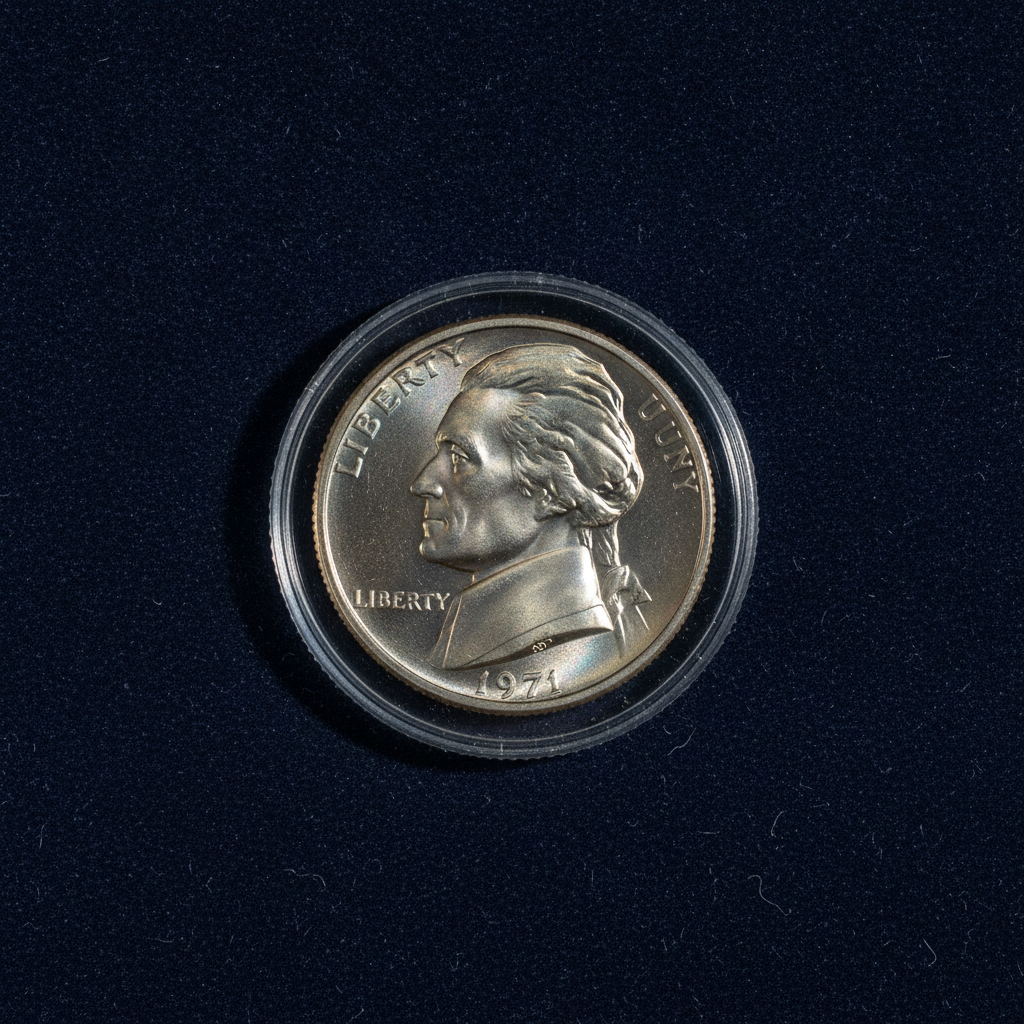
Only 1,655 examples of the 1971 No-S Proof Jefferson Nickel (FS-501) are confirmed to exist — and every single one of them left the San Francisco Mint by accident. No other proof coin in the entire Jefferson Nickel series, which stretches from 1938 to the present, carries this distinction. This is the only proof issue in the set that went out the door without its intended mintmark. That's not a footnote. That's the whole story.
The error originated when an obverse die — missing the S mintmark that should have been punched in to identify its San Francisco origin — was inadvertently used to strike proof coins destined for that year's official U.S. Proof Sets. The sets were packaged, distributed, and sold to the public before anyone caught the mistake. By the time collectors started pulling their 1971 sets apart and comparing nickels, the error had already dispersed into the market.
How a Die Prep Mistake Became a Modern Rarity
Mintmark application in the early 1970s was still a manual process. Individual mintmark punches were applied to working dies by hand before those dies entered production — a system that left obvious room for human error. The Mint transitioned to hub-punched mintmarks later in the decade, largely eliminating this category of mistake. That timing matters: the 1971 No-S sits at the tail end of an era when these errors were physically possible at scale.
What makes this particular error so significant isn't just the missing S — it's the context. Proof coins are supposed to represent the pinnacle of Mint craftsmanship. They're struck on specially prepared planchets, using polished dies, for collectors. The idea that a proof set could ship with an unintended error coin cuts against everything the proof program is supposed to stand for. That irony is part of what drives collector demand.
The 1971 No-S is catalogued as FS-501 in the Flynn-Spadone reference, the standard attribution guide for Jefferson Nickel varieties. It's not a subtle die crack or a microscopic doubling — the mintmark is simply absent. Authentication is straightforward for any competent grader.
What the Market Looks Like Today
PCGS and NGC have both certified examples across a wide grade range, with cameo and deep cameo designations commanding serious premiums over non-cameo counterparts. In proof coinage, the contrast between frosted devices and mirror fields is everything — a PR-65 Deep Cameo example trades at a dramatically different level than a straight PR-65.
Recent Heritage Auctions results show PR-67 Deep Cameo examples consistently clearing the $500–$750 range, with top-pop specimens graded PR-68 DC pushing well past $1,000 at major sales. The population at the highest grades is thin — PCGS has certified only a handful of examples at PR-68 across both cameo tiers — which keeps the ceiling open for registry-grade coins.
At more accessible grades, a problem-free PR-65 without cameo designation can still be had in the $150–$250 range, making this one of the more attainable major modern U.S. coin rarities. That accessibility is part of its appeal. This isn't a coin that exists only in the portfolios of institutional collectors.
For context: the 1990 No-S Proof Lincoln Cent — arguably the closest modern analog in terms of error type and collector profile — commands multiples of these figures, with PR-69 DC examples regularly exceeding $3,000. The 1990 No-S has a smaller known population, which explains much of the gap. But the 1971 Jefferson has history on its side; it was the first major no-mintmark proof error of the modern era, and it set the template for how collectors think about this entire error category.
Check Your Proof Sets
The practical reality is that not every 1971 Proof Set has been broken apart and examined. Original, unopened sets still surface at estate sales, flea markets, and general antique dealers who have no idea what they're sitting on. The coin looks identical to a standard 1971-S proof nickel — same design, same finish — except for the absence of that single letter below the date.
Any collector who owns a 1971 U.S. Proof Set and hasn't verified the nickel's mintmark status should do so before the set changes hands. A loupe and thirty seconds is all it takes. The S mintmark on a standard example sits just to the right of Monticello's steps, below the date. If it's not there, you're not looking at a common coin.
With a confirmed population of 1,655 pieces spread across the entire collector base — raw, certified, and still sealed in original sets — the 1971 No-S Proof Jefferson Nickel remains one of the most compelling finds hiding in plain sight in American numismatics. The next one might already be in someone's attic.