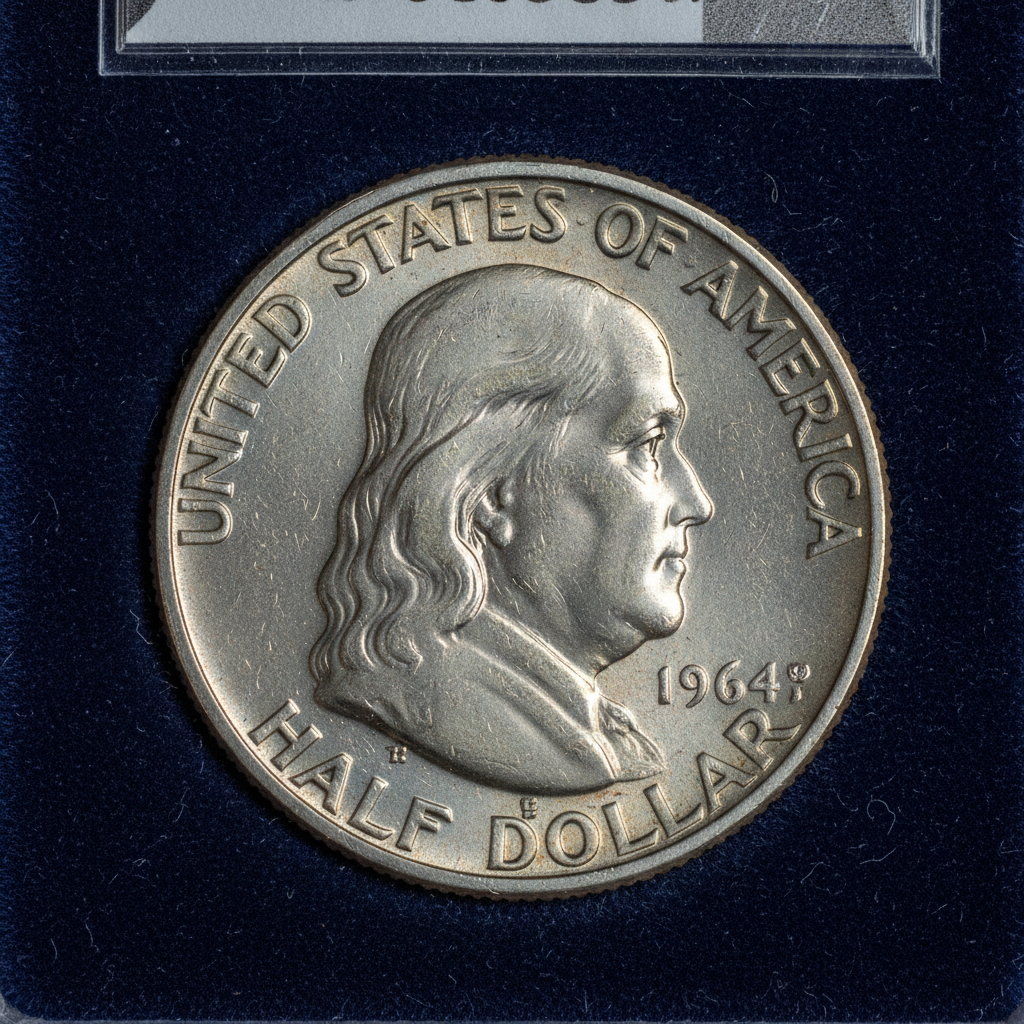
The 1961 Proof Franklin Half Dollar FS-801 is one of those coins that rewards patience. Casual observers see a standard Proof issue — mirror fields, sharp devices, the familiar profile of Benjamin Franklin anchoring the obverse. But flip it to the reverse, and something is wrong. Or rather, something is very, very right.
The doubling on this variety is unmistakable once you know where to look. The motto E PLURIBUS UNUM splits visibly under magnification, with secondary impressions pushing outward from the primary lettering. The effect is bold enough that the Red Book — R.S. Yeoman's A Guide Book of United States Coins, the closest thing numismatics has to scripture — lists it as a recognized variety. That's not a small thing. The Red Book doesn't hand out listings to every doubled die that crosses a grader's desk.
What Makes FS-801 Different From the Noise
The Fivaz-Stanton designation FS-801 places this variety within the established doubled die classification system, which means it has been verified, catalogued, and deemed significant enough to carry a permanent reference number. For Franklin Half collectors, that designation functions as a quality filter. There are dozens of minor hub doubling incidents across the series — most are curiosities, not collectibles. FS-801 is the latter.
The doubling itself originates on the reverse hub, affecting the lettering with enough consistency across surviving examples that attribution is reliable even on circulated pieces — though circulated Proofs are a story in themselves. The 1961 Proof Franklin was struck at Philadelphia, with the Mint producing approximately 3,028,244 Proof sets that year. High mintage, by Proof standards of the era, which ordinarily suppresses premiums. But FS-801 is a subset of that population, not a stand-in for it, and the overlap with a specific cameo characteristic is where the real market story begins.
The Cameo Factor and Its Market Consequences
Franklin Half Dollars are notoriously difficult to find with true cameo contrast — the frosted devices against deeply mirrored fields that define a premium Proof strike. The Mint's die preparation practices in the late 1950s and early 1960s were inconsistent. Dies were used until they wore down, and the cameo frost that appears on early strikes fades quickly. By the time a die had struck several hundred coins, the contrast was gone.
This is where FS-801 becomes genuinely interesting as a market proposition. Collectors pursuing this variety aren't just chasing a doubled die — they're chasing a doubled die with cameo designation, which narrows the available population sharply. PCGS and NGC both recognize cameo and deep cameo designations for this era, and the premium between a straight Proof 65 and a Proof 65 Deep Cameo on a Franklin can run five to ten times the base price depending on the date. For a recognized variety like FS-801, that multiplier compounds.
At auction, strong examples have surfaced through Heritage and Stack's Bowers over the past several years, with deep cameo specimens in the PR65DCAM to PR67DCAM range drawing serious competitive bidding from both Franklin specialists and variety collectors. A PR66DCAM example of a premium Franklin variety in this window can clear $500 to $2,000 depending on eye appeal and population context — and population on the FS-801 with cameo designation remains thin enough that individual auction results still move the needle on perceived value.
The Collector's Calculus
Franklin Half Dollars as a series have been quietly appreciating. The series ran from 1948 through 1963, replaced by the Kennedy Half after the assassination, and the combination of historical resonance, finite date-and-mintmark combinations, and a robust variety community has kept collector interest durable. The FS-801 sits at an interesting intersection: it's accessible enough that a focused collector can realistically acquire an example, but specific enough — particularly in higher grades with cameo — that true upgrades are genuinely scarce.
For dealers, it's a coin worth knowing on sight. The doubling is visible without a loupe under good lighting on strong examples, which means it occasionally surfaces in bulk Proof lots where the seller hasn't done the attribution work. Those opportunities are rarer than they were a decade ago — the internet has made attribution literacy more widespread — but they haven't disappeared entirely.
The 1961 Franklin FS-801 isn't the most dramatic doubled die in American coinage. It won't clear six figures at a major auction. But it represents exactly the kind of variety that serious numismatists build careers around: documented, attributable, historically anchored, and just scarce enough in premium condition to make the hunt worthwhile. The Red Book agreed. That's usually where the story ends — and where collector demand begins.