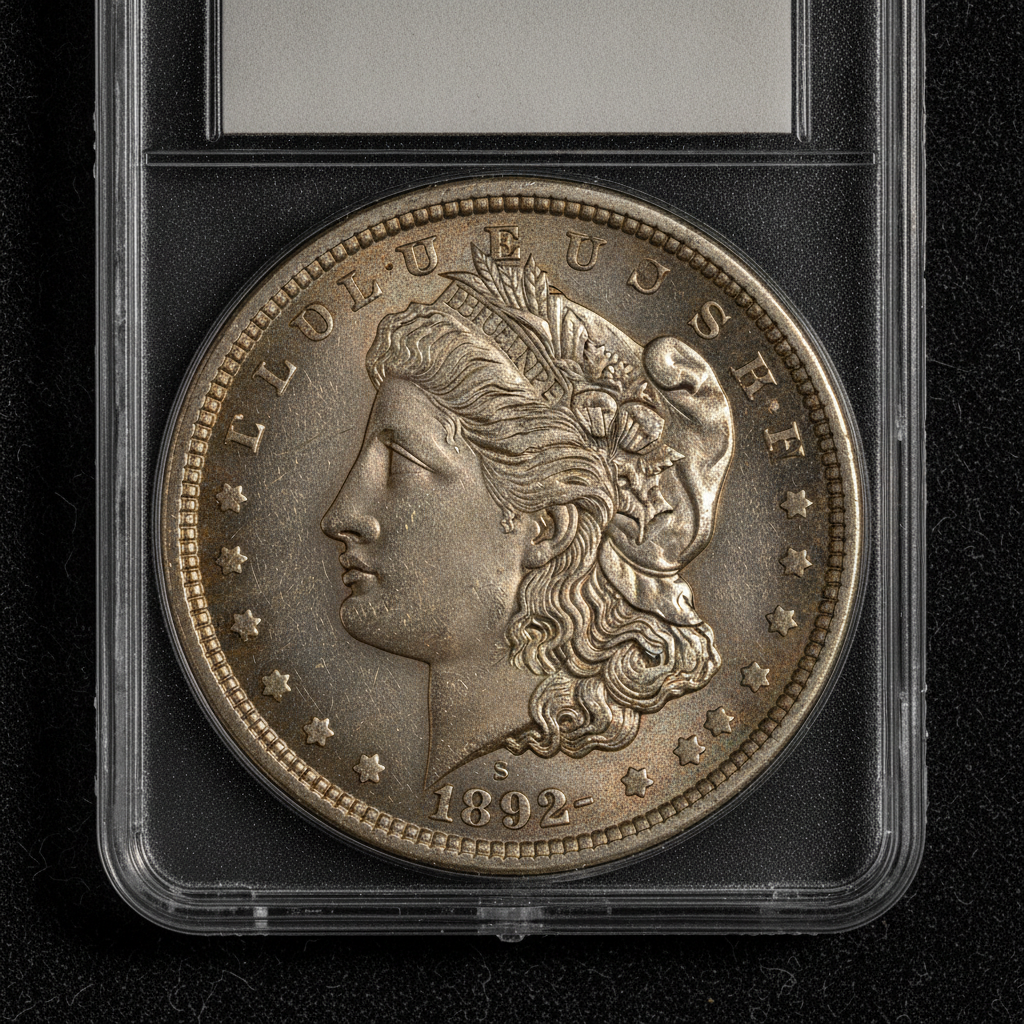
Most coins earn their rarity through low mintage numbers. The 1892-S Morgan dollar earned its through something far more brutal — it was spent, worn, melted, and spent again until almost nothing remained. The San Francisco Mint struck 1,200,000 of them that year. A perfectly respectable number. The problem is that nearly all of them circulated immediately into a California economy that had no interest in preserving them.
What survived is a masterclass in why population data matters more than original mintage figures, and why a single high-grade example can reframe an entire coin's market narrative.
A Mint That Did Its Job Too Well
San Francisco in 1892 was not a city that hoarded its silver. The West Coast economy ran on coin, and Morgan dollars moved through commerce at a pace that Eastern markets rarely matched. Unlike certain Philadelphia and New Orleans issues that sat in Treasury bags for decades — emerging decades later in gem condition through the GSA hoard releases of the 1970s — the 1892-S had no such luck. It circulated hard and fast from the moment it left the Mint.
Then came the Pittman Act of 1918, which authorized the melting of up to 350 million silver dollars to support British war financing and stabilize the silver market. Circulated Morgans — exactly the kind the 1892-S produced in abundance — were the primary casualties. Coins that had already seen years of commercial use were smelted by the millions. The 1892-S, already worn from decades of pocket-to-pocket travel, had no protection.
The result: a coin with a seven-figure original mintage that now grades like a key date in circulated condition and behaves like a major rarity above MS-63.
What the Population Data Actually Says
PCGS currently lists the 1892-S Morgan in MS-65 as a genuine condition rarity, with survivors in Superb Gem territory numbering in the single digits across both major grading services. The combined PCGS and NGC population above MS-64 remains extraordinarily thin — a stark contrast to the 1.2 million coins that once existed.
For context, compare that to the 1881-S Morgan, one of the series' most common dates, which PCGS has graded in the thousands at MS-65 and above. The 1892-S at that same grade is not just scarcer — it is a different category of coin entirely. Collectors who approach it expecting typical Morgan dollar availability will be corrected quickly by auction results.
At the MS-63 level, PCGS values hover around $1,200–$1,500, reflecting a coin that is attainable but already commands a meaningful premium over common-date Morgans. Push into MS-64 territory and prices escalate sharply, with recent Heritage and Stack's Bowers auction records placing strong examples in the $8,000–$14,000 range depending on surface quality and eye appeal. A certified MS-65 example — should one surface at major auction — would almost certainly exceed $50,000, with a CAC-stickered specimen potentially pushing well beyond that threshold.
That kind of grade premium compression — the steep jump between MS-63, MS-64, and MS-65 — is the signature of a true condition rarity. It tells you the market understands exactly how few problem-free gems exist.
The Survivor That Changes the Story
The existence of even one Superb Gem 1892-S is, frankly, remarkable. A coin that circulated freely in a high-velocity commercial economy, survived the Pittman Act melts, and emerged a century later with full luster and minimal contact marks represents a specific kind of numismatic miracle — the coin that somehow avoided every trap history set for it.
These survivors tend to share a common biography: pulled from circulation early, perhaps saved by a collector or merchant who recognized something worth keeping, then passed through careful hands for generations before entering the formal grading and auction ecosystem. The details are usually lost. What remains is the coin itself, and what the surfaces tell graders about a life mostly unlived in commerce.
For Morgan dollar specialists, the 1892-S occupies a specific and underappreciated tier. It is not a 1893-S — the series king with a 100,000 mintage that commands six figures in any Mint State grade. It does not carry the same name recognition as the 1895 Proof-only Philadelphia issue. But among serious date collectors building complete Mint State sets, the 1892-S is one of the coins that quietly ends collections. The budget runs out. The population is too thin. The right coin simply does not appear.
Mintage numbers are a starting point, not a conclusion. The 1892-S spent 130 years proving it.