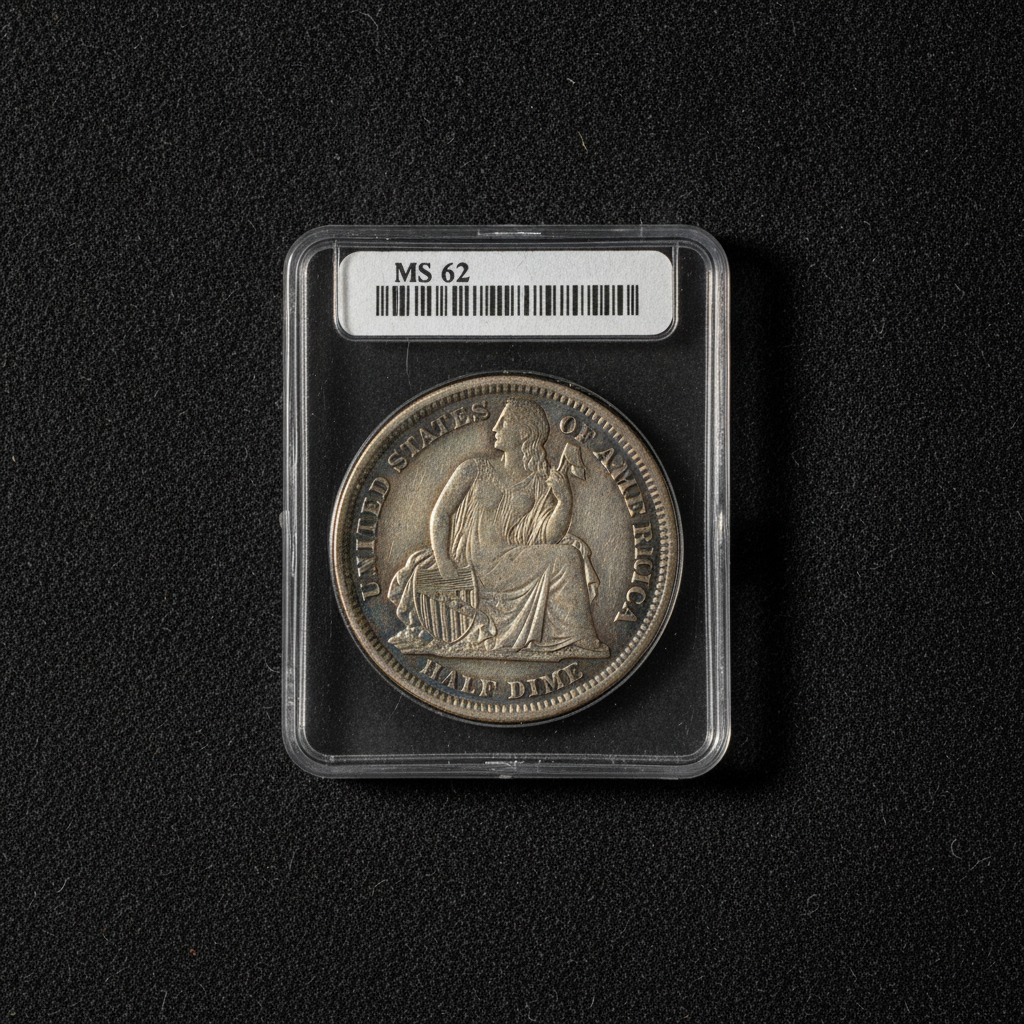
Most collectors walk right past it. At 15.5 millimeters wide and 1.24 grams of silver, the 1859 Liberty Seated Half Dime is easy to dismiss as a minor date in a long-running series. That would be a mistake. Buried inside this coin's production history is one of the Philadelphia Mint's least-discussed design interventions — a quiet reworking attributed to engraver Anthony C. Paquet that most collectors never notice, and most price guides never adequately explain.
The Liberty Seated series ran from 1837 to 1891, and by 1859 it had already cycled through multiple hub revisions. Christian Gobrecht's original design had been modified by James Longacre, and the series carried the visual fingerprints of several hands by the time Paquet — then an assistant engraver at the Mint — began making subtle adjustments to the working dies. His involvement in the 1859 issue represents the kind of transitional numismatic moment that doesn't make headlines but absolutely moves prices when collectors finally understand what they're holding.
What Paquet Actually Changed
Paquet's modifications to the 1859 half dime were not a wholesale redesign. They were refinements — adjustments to the portrait's relief, the positioning of stars on the obverse, and the treatment of the legend lettering. Subtle, yes. Insignificant, no.
In numismatics, die variety attribution is the discipline that separates serious collectors from casual accumulators. The Paquet-linked characteristics on the 1859 issue are identifiable under magnification and have been catalogued by variety specialists, though the coin lacks the mainstream recognition of, say, a 1856 Flying Eagle Cent or a 1877 Indian Head Cent — coins where the story has been told loudly and repeatedly. The 1859 half dime's story has been told quietly, which is precisely why it still offers collector value that isn't fully priced in.
The Philadelphia Mint's total mintage for the 1859 half dime came in at 340,000 pieces — not a rarity by raw numbers, but survival rates in higher grades tell a different story. Half dimes circulated heavily. They were pocket change in the most literal sense, and most examples spent years in commerce before anyone thought to save them.
The Grade Ladder and What It Costs You
In circulated grades, the 1859 half dime is genuinely affordable. VF-20 to EF-45 examples trade regularly in the $40–$120 range depending on eye appeal and strike sharpness. That accessibility makes it a legitimate entry point for type collectors building a Liberty Seated set on a budget.
The calculus changes sharply above MS-63. Mint State survivors with full luster and clean fields are legitimately scarce. PCGS and NGC combined population data for the 1859 half dime in MS-65 and above sits in the low dozens — the kind of number that should make any serious type collector pay attention. At that grade tier, auction results through Heritage Auctions and Stack's Bowers have pushed into the $1,500–$4,000 range for exceptional examples, with a handful of gem-quality pieces exceeding that ceiling when strong collector demand converges with limited supply.
Proof examples are another category entirely. The Philadelphia Mint struck proof half dimes for collectors throughout the Liberty Seated era, and the 1859 proof mintage is estimated at approximately 800 pieces. In PR-65, expect to pay north of $1,200; deep cameo examples at that grade level are genuinely rare and command premiums that reflect it.
- Circulated (VF-EF): $40–$120
- Mint State MS-63: $300–$600
- Mint State MS-65: $1,500–$4,000+
- Proof PR-65: $1,200–$2,500+
- Proof PR-65 Deep Cameo: $3,000+
Why the Paquet Connection Still Matters to the Market
Paquet's broader reputation in American numismatics rests largely on his ill-fated 1861 Double Eagle reverse design — a coin recalled almost immediately after striking because its high-relief lettering caused stacking problems. That episode overshadowed the rest of his Mint career, and his quieter contributions to series like the Liberty Seated half dime have never received proportional attention from the hobby press.
That asymmetry is a market inefficiency. Coins with documented design provenance — where a specific engraver's hand can be tied to identifiable characteristics — tend to appreciate when that story reaches a wider audience. The 1856-O Liberty Seated Dollar with its Longacre attribution saw renewed collector interest precisely because the attribution story was told well and repeatedly. The 1859 half dime is waiting for the same treatment.
For a coin that weighs barely more than a gram, it carries a disproportionate amount of numismatic history. Paquet's fingerprints are there for anyone willing to look closely enough — and in this market, the collectors who look closely first are usually the ones who profit most.