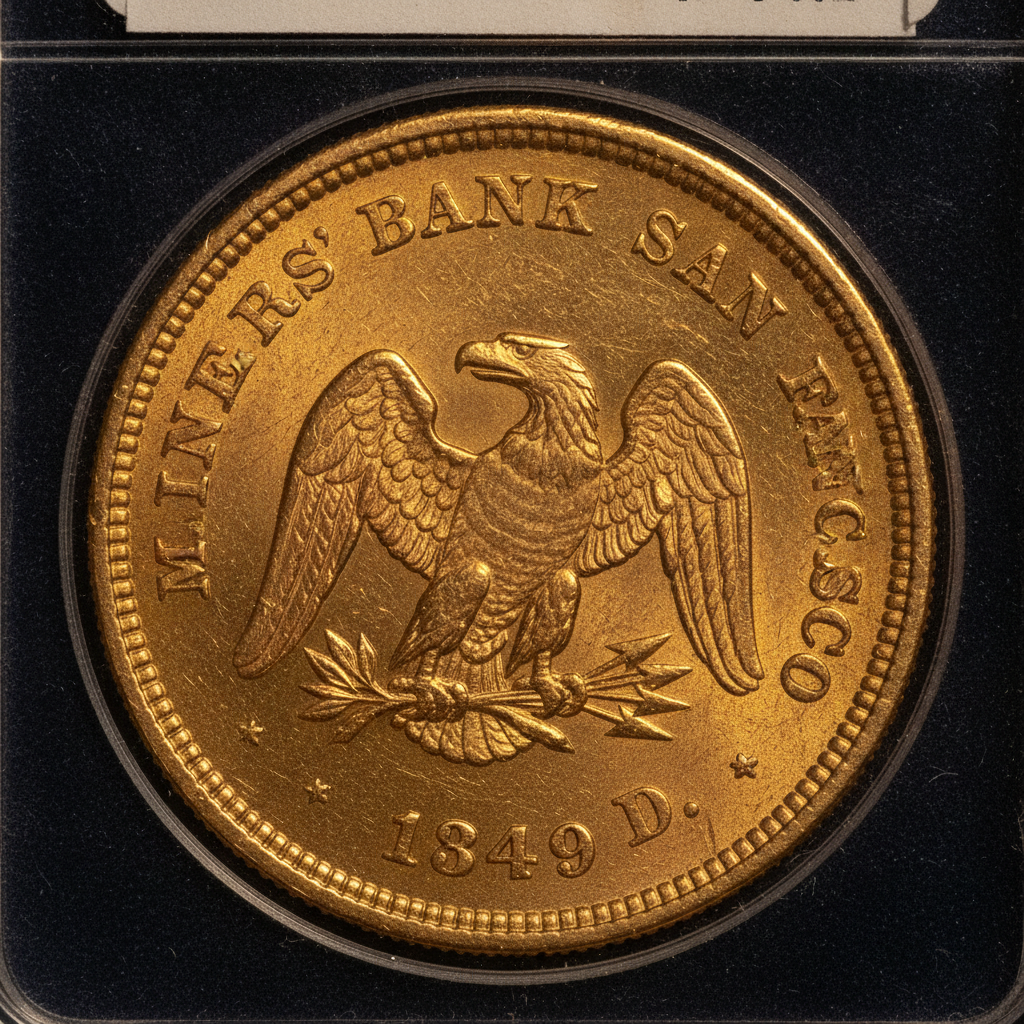
Before the U.S. Mint could keep pace with California's gold fever, a handful of private operations stepped in to fill the void — and at least one of them nearly destroyed the trust it was meant to build. The 1849 Miners' Bank $10 gold coin is the physical artifact of that experiment, and a rare Plain Border example is now heading to auction through GreatCollections.
This is not a coin that simply circulated through Gold Rush commerce. It circulated through a scandal.
San Francisco, 1849: Private Mints and Public Desperation
The California Gold Rush created an immediate, practical crisis: too much raw gold, not enough coined money. Merchants, miners, and trading houses needed a medium of exchange, and the nearest official U.S. Mint was thousands of miles away in Philadelphia. Private mints rushed to fill the gap, striking coins of varying quality and, critically, varying honesty.
The Miners' Bank was established in San Francisco in 1849 by a group that included Wright, Hays & Company. Their $10 piece — sometimes called a "slug" in the vernacular of the era — was struck from California placer gold and intended to function as a trusted circulating coin. The design is stark and purposeful: an eagle on the reverse, the denomination and issuer on the obverse, with either a plain or reeded border depending on the striking.
The problem, which became apparent quickly, was the coin's gold content. Independent assays found the Miners' Bank $10 pieces to be underweight and substandard in fineness — worth measurably less than their face value suggested. In a market already operating on improvised trust, that was a catastrophic revelation. The bank collapsed within months of opening, and the coins that survived became artifacts of both ambition and failure.
What Makes the Plain Border Variety Significant
Two major varieties of the 1849 Miners' Bank $10 exist: the Plain Border and the Reeded Border. Both are rare by any standard, but the Plain Border is generally considered the more elusive of the two and commands stronger collector interest when it surfaces. Population data across the major grading services reflects just how infrequently these pieces come to market in any condition — examples in problem-free, gradeable states are genuinely exceptional.
California private gold as a category has long attracted a specific, serious type of numismatist — one drawn to historical weight as much as metallic content. These coins predate the San Francisco Assay Office (established 1851) and the San Francisco Mint (1854), making them primary documents of the chaotic interlude between the gold discovery at Sutter's Mill and the federal government's eventual monetary response. No other coins occupy that particular historical window quite like the private California issues of 1849 and 1850.
For context, comparable California private gold pieces — particularly those with documented provenance and clean surfaces — have performed strongly at major auction houses including Heritage Auctions and Stack's Bowers. A Norris, Gregg & Norris $5 half eagle from 1849, another foundational California private issue, has brought well into five figures in higher grades. The Miners' Bank pieces, given their direct scandal narrative and shorter production window, arguably carry even more historical freight.
The Auction and What Collectors Should Know
GreatCollections, the Irvine, California-based auction platform known for transparent pricing and strong numismatic consignments, is offering this Plain Border example as part of an upcoming sale. The firm has built a reputation for bringing legitimately rare coins to a broad bidder base without the sometimes-opaque fee structures of larger houses — a meaningful consideration when bidding on a coin where the spread between grades can represent thousands of dollars.
Collectors entering the California private gold market for the first time should understand a few realities:
- Authentication is non-negotiable. Counterfeits and altered examples exist, and only coins certified by PCGS or NGC should be considered for serious money.
- Surface issues are common given the improvised refining processes of the era — don't expect gem surfaces, and don't penalize coins unfairly for period-appropriate characteristics.
- Provenance matters more here than in almost any other U.S. coin series. A coin with a documented auction trail adds meaningful confidence.
- The Plain Border and Reeded Border varieties are not interchangeable in value — know which you're bidding on.
The Miners' Bank lasted less than a year. The coins it produced have now survived 175 years. That the institution failed partly because it couldn't be trusted with gold — and that we're still talking about its coins — is the kind of irony that makes numismatics worth paying attention to.