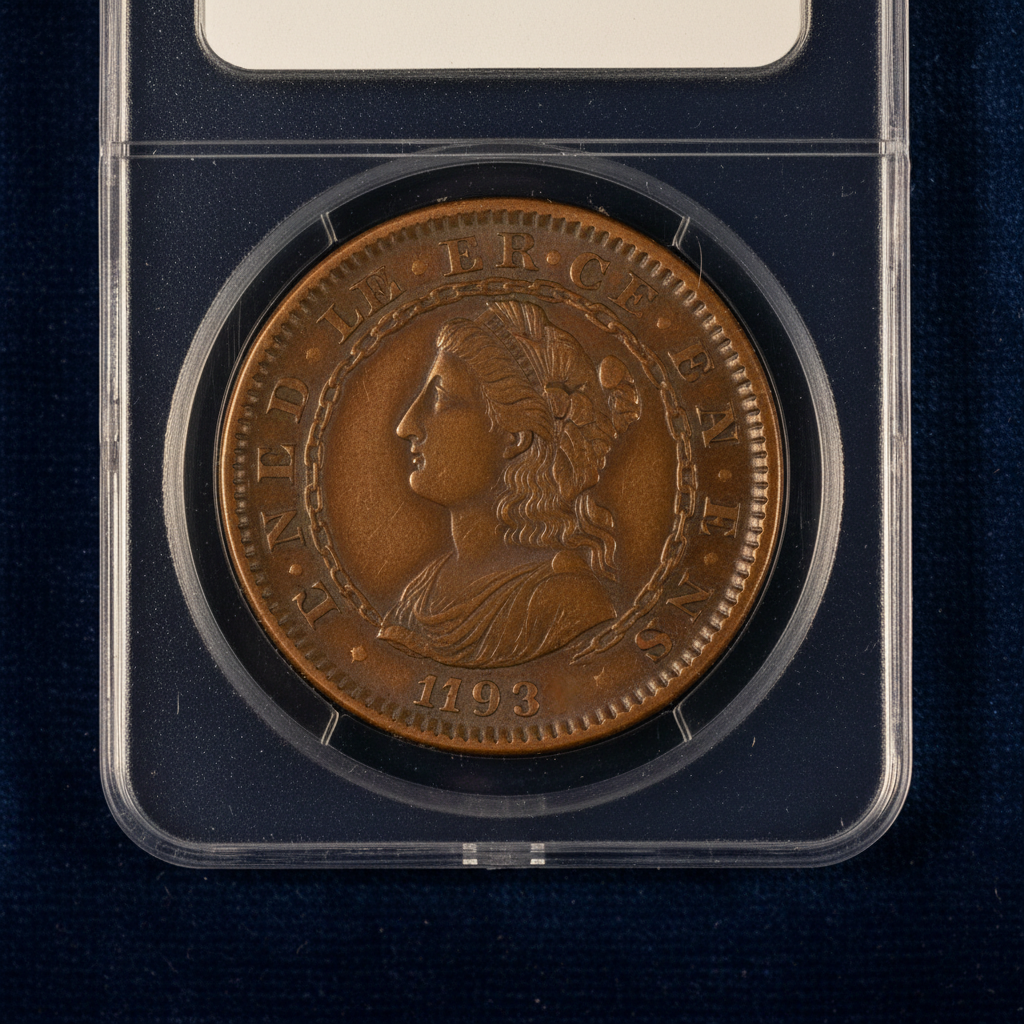
Before there was a dollar coin, before there was a Morgan, before there was anything recognizable as American numismatics — there was the Chain Cent. Struck beginning March 1, 1793, in Philadelphia's newly built Mint facility, the 1793 Chain Cent holds a designation no other coin in U.S. history can claim: it was the first cent the United States Mint ever produced, and the first coin struck inside the Mint building itself.
Twelve days of intermittent production. That's all it took to create one of the most coveted series in all of early American coinage.
The Birth of American Copper
Henry Voigt, the Mint's first Chief Coiner, oversaw the production run that generated 36,103 Chain Cents across two major varieties — the AMERI. variety, where the word America was abbreviated due to a die spacing error, and the AMERICA variety that followed as a corrective measure. A third variety, distinguished by a period after LIBERTY, rounds out the series for specialists chasing a complete type set.
The obverse design featured a portrait of Liberty — crude by later standards, intentionally raw by the aesthetic norms of the era — surrounded by the inscription LIBERTY and the date. The reverse bore a chain of 15 links, one for each state then in the Union, encircling the denomination ONE CENT and the fraction 1/100. The chain motif, meant to symbolize unity, was almost immediately criticized by contemporary observers as evoking bondage rather than solidarity. That controversy contributed directly to the design's rapid replacement by the Wreath Cent later in 1793.
Its reign lasted less than a year. That brevity is precisely what makes it extraordinary.
What the Market Says Now
Chain Cents are genuinely rare in any collectible grade. PCGS and NGC combined populations in grades VF20 and above remain firmly in the dozens — not hundreds — for most varieties, making this a coin where a single auction result can meaningfully reset market expectations.
At Heritage Auctions, a PCGS-graded VF35 example of the AMERI. variety brought $156,000 in a recent major sale, a figure that underscores just how aggressively serious collectors are pursuing early American copper. Problem-free, original-surface examples command significant premiums over cleaned or tooled coins — a gap that can easily reach 50% or more between an AU55 with issues and a clean VF30.
The grading nuances here matter enormously. Early American copper is notorious for environmental damage, cleaning, and post-mint alterations. PCGS and NGC both offer designation services that flag original surfaces, and a coin carrying a CAC sticker — the Certified Acceptance Corporation's endorsement of quality within grade — can trade at multiples above its uncertified peers. For Chain Cents specifically, a CAC-approved example in any circulated grade above Good is a meaningful market event.
Stack's Bowers has also handled notable Chain Cent appearances through its Americana sales, where the coin's historical narrative drives bidding well beyond strict condition-value calculations. This is a coin that sells its own story, and serious bidders know it.
Building a Chain Cent Collection
For collectors approaching this series, the entry point is real but not insurmountable. A genuine, problem-free example in AG3 or G4 — where the chain is visible and the date is clear — can be acquired in the $8,000 to $15,000 range depending on variety and eye appeal. That's not pocket change, but for a coin that is literally the foundation of American coinage, it's a remarkably accessible price of admission.
- AMERI. Variety (S-1): The rarest of the three, distinguished by the abbreviated reverse legend. Commands the highest premiums at every grade level.
- AMERICA Variety (S-2): More available than S-1 but still genuinely scarce. The workhorse of the series for type collectors.
- Period After LIBERTY (S-3): A die-state curiosity that appeals to specialists and variety hunters. Population is thin across all grades.
The Sheldon numbering system — yes, the same Dr. William Sheldon who gave us the 1-70 grading scale — was originally developed specifically to catalog early American large cents, and the Chain Cent sits at the very beginning of that catalog. There's a certain poetry in the fact that the coin that started American coinage also helped start systematic American numismatic scholarship.
Collectors serious about early American copper should monitor Heritage's Central States and FUN sales, where the deepest pools of specialist buyers converge. Patience is a strategy here — the right Chain Cent at the right grade doesn't appear every quarter, and overpaying for a problem coin in this series is a mistake that takes years to recover from.
The 1793 Chain Cent isn't just old. It's the beginning of everything. And the market prices it accordingly.