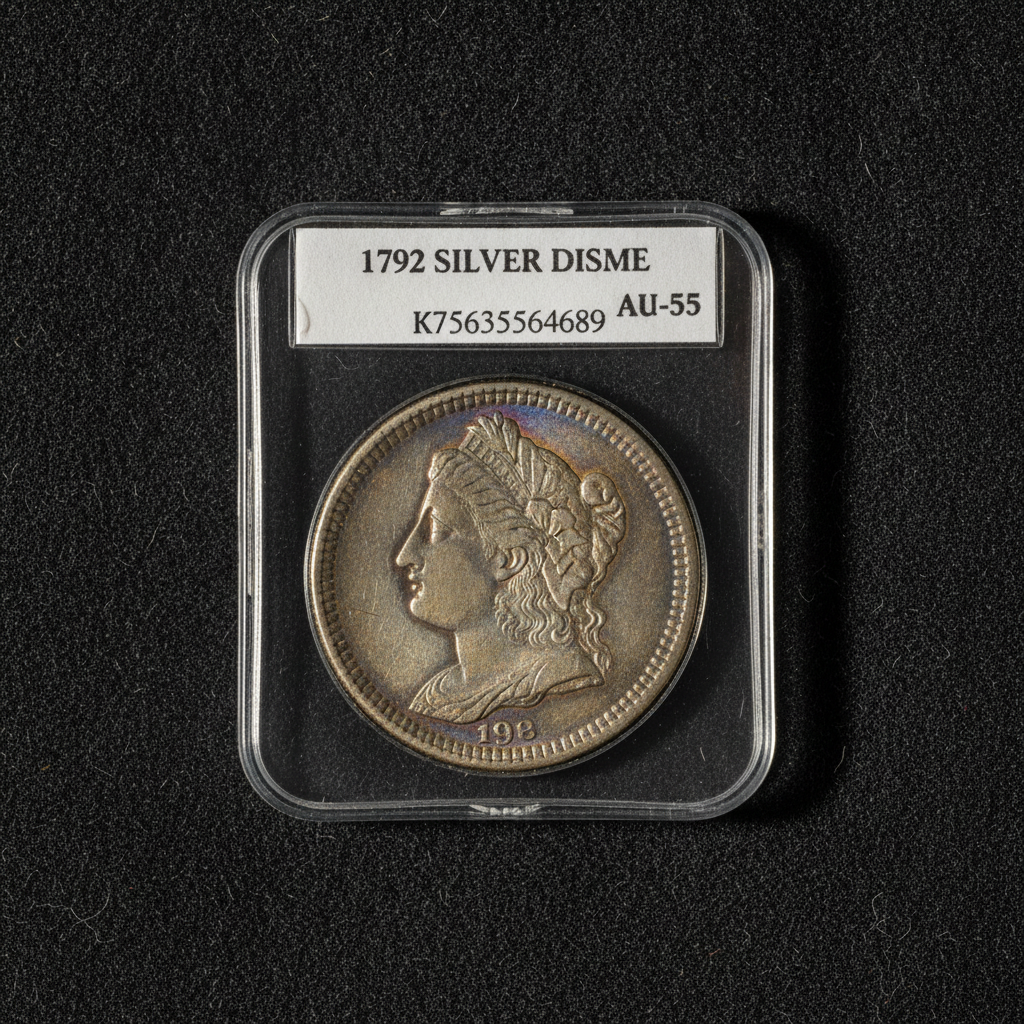
Before the United States Mint had a building, before it had staff, before it had a functioning press capable of striking coins at scale, it had a idea — and fifteen silver dismes struck in the summer of 1792 to prove it. The 1792 Silver Disme is not merely America's first dime. It is the physical argument that a fledgling republic could govern itself, finance itself, and define its own iconography without borrowing either the imagery or the authority of a European crown.
That argument very nearly went unrecorded.
A Coin Born in a Basement, Not a Mint
The Mint Act of April 2, 1792 authorized the establishment of a national coinage system, but the Philadelphia Mint wasn't operational yet when Congress needed to demonstrate progress. The solution was improvised and urgent: a small number of dismes — the archaic spelling derived from the French dixième, meaning tenth — were struck in a private cellar, almost certainly using silver supplied by George Washington himself, though that detail remains historically contested.
What isn't contested is the design. The obverse features a flowing-haired Liberty with the inscription LIBERTY and the date 1792. The reverse carries an eagle and the denomination HALF DISME or DISME depending on the denomination struck. The artistry is attributed to Robert Birch, and the dies were engraved under the supervision of Henry Voigt, the Mint's first chief coiner. These were not test strikes in the modern sense. They were political objects — tangible proof of concept delivered directly to Congress.
The mintage for the Silver Disme is estimated at approximately 1,500 pieces, though surviving examples number in the dozens at best. The Half Disme, struck in greater numbers at roughly 1,500 pieces as well, is better documented and more frequently encountered at auction. The Silver Disme itself is dramatically rarer in high grade.
What Survivors Sell For Today
When a 1792 Silver Disme surfaces at auction, the market responds accordingly. A PCGS SP-67 example — the finest certified — sold at Stack's Bowers for $2,760,000 in 2021, setting a benchmark that reflects both the coin's historical weight and its near-total absence from the market. Even problem-free examples in the VF-30 to EF-45 range routinely clear $500,000 to $800,000 at Heritage Auctions, where the coin appears perhaps once every few years.
The population data underscores the scarcity. PCGS has certified fewer than 20 examples across all grades, with the overwhelming majority falling below MS-60. NGC's census is similarly thin. For context, the 1804 Silver Dollar — the so-called King of American Coins — has 15 known examples. The 1792 Silver Disme isn't far behind in rarity, and in historical significance, it arguably surpasses it.
The collector base for early American coinage has deepened considerably over the past decade. The same institutional appetite that drove rare coin prices to record territory during the 2020–2022 bull market hasn't fully retreated. Type collectors and museum-quality registry builders continue to treat pre-federal and early federal coinage as the apex of the American numismatic canon, and the 1792 issues sit at the very top of that hierarchy.
Why This Coin Refuses to Be Forgotten
Part of what makes the 1792 Silver Disme so enduring as a collectible — and as a story — is the tension embedded in its origin. It was struck before the institution that was supposed to strike it existed. It was distributed as a political demonstration before it could function as actual currency. And for long stretches of the 19th century, it was barely documented, surviving in private hands without the kind of provenance trail that numismatists now expect.
Several of the finest known examples carry pedigrees tracing back to 19th-century collections assembled by figures like Matthew Stickney and Joseph Mickley — names that appear repeatedly in the genealogy of great American rarities. When a coin's ownership history reads like a who's-who of early American numismatics, it tends to command a premium that pure grade alone cannot explain.
The 1792 Silver Disme also benefits from a kind of narrative gravity that few coins possess. It represents a moment when the outcome of the American experiment was genuinely uncertain — when the decision to put Liberty on a coin rather than a monarch's profile was a statement of intent, not a foregone conclusion. Collectors who understand that context aren't just buying a coin. They're buying a piece of the argument.
For a denomination that almost didn't survive its first year, the disme has proven remarkably durable.